
DRUMMING: BUD
(To read previous episodes of DRUMMING, click on slingerland and talent test and hands and honey and honey2 and vignettes and Montmartre)
(Note: Portions of this post appeared earlier under the title “The Empty Suitcase.”)
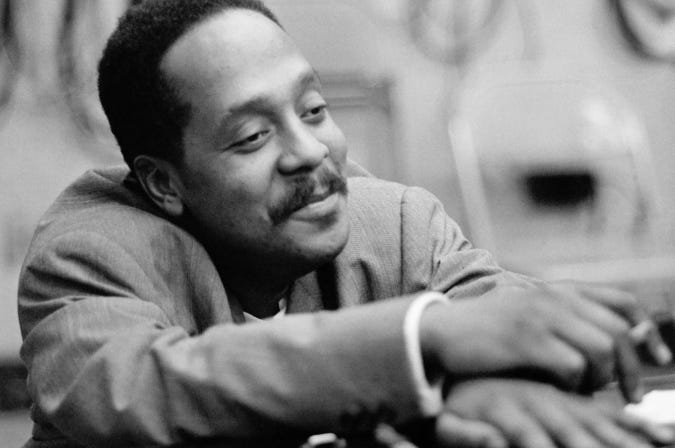
The Montmarte had been buzzing with the imminent arrival of piano legend Bud Powell, scheduled to debut the following Tuesday. Then during our last set on Sunday, Dexter Gordon unexpectedly announced him from the stage. From my seat behind the drums, I watched Bud Powell emerge from behind the bar in back. He was wearing a beret, an overcoat a little long at the sleeves, a suit and tie beneath. He looked to be about forty (he was thirty-eight), stout, with a mocha complexion and a thin, trimmed mustache. He strode deliberately through the club toward the bandstand with an expressionless mien, his left arm swinging slowly at his side, seeming to part the applauding audience like water (a space-altering effect celebrated in Thelonious Monk’s tribute “In Walked Bud”).
He stepped onto the Montmartre stage and took a seat at the piano. He began playing the intro to “Celia,” a graceful, lyric composition of his, and Niels and I slid into an easy groove.
Of course I knew his work from the epochal recordings of the late 1940’s and early ‘50’s, flights of conceptual fluency and drive that modeled the language every jazz pianist since has been obliged to use. Only Charlie Parker rivaled his improvisatory powers. His early difficulties were part of jazz lore - epic tales of art and betrayal, martyred genius, drugs and alcohol, asylums and jails, mental breakdowns, heroic performances (“Were you there that night at Birdland when Bud Powell played 44 choruses of ‘Cherokee’?”). The mordant titles of his compositions - “Dance of the Infidels,” “Oblivion,” “Glass Enclosure” - suggested a mind off in its own strange corner. He’d moved to Paris in the late 1950’s - a shadow of his former self, some said - and often worked there with his trio at the Blue Note.
Bud began his solo in a welter of lapses, flubs, fluffs. Slowly he gained footing and moved forward; still, I heard only an echo of his recorded brilliance. At best he sounded like a slightly fuzzy Bud Powell imitator. From time to time he looked balefully up at Niels or me, lost in a cloud, it seemed.
We finished up the tune to polite applause. It was an awkward, disturbing, unpersuasive debut.
I laid my sticks down on the bass drum, my mind full of questions. Perhaps Bud’s seeming flatness was an illusion. Had his disciples so thoroughly imitated and absorbed him that the original sounded weak? Maybe the next generation, into freer forms, had buried the mainstream bop innovators’ message beyond recognition. Yet Dexter Gordon was from the same era, and his intense, integral improvisations still commanded; Miles Davis’ still broke new ground.
Backstage I found Bud sitting with his hands in his lap, a puzzled, bedraggled expression on his face. A large black woman in a hat was standing over him.
“That’s it for you, Bud Powell,” she railed. “I’m leaving!” She turned and stormed out.
Buttercup, Bud’s common law wife and court-appointed caretaker, furious that Herluf, the club’s owner, had given Bud an advance (which he’d used to get drunk) instead of turning it over to her, left for Paris that night, taking Bud’s suitcases with her, leaving him with nothing but the clothes he was wearing.
Herluf quickly appointed Petrus, the Dutch pianist and Bud Powell acolyte, to be Bud’s caretaker. Each day Petrus went to Bud’s apartment near the club and saw that his lone suit and shirt were pressed and that he was shaved and ready for work, then fetched him a taxi to make sure he arrived at the club on time.
A week earlier, I’d come downstairs to find a girl cleaning the club kitchen. Eva was nineteen , an art student, just back from London, where her relationship with an English musician had gone bad. Herluf had given her a job in the club while she figured out what to do next before art school resumed.
Eva was part Inuit, with wide cheekbones and sloe eyes beneath jet-black bangs. Smart, inward, and alluring, she had no shyness. Our first lovemaking, at a friend’s apartment where she was staying, was frank and guileless (so different from the tortured, ambivalent sexual battlefields of my American youth).
Weeks passed in creative ferment, each night brimming with intense beauty and peril. I drummed with the ad hoc Dexter Gordon Quartet (me, Niels, Petrus) and the Bud Powell Trio (me, Niels), then Dex again, then Bud. My recent troubles seemed insignificant beside the heavy baggage Dex and Bud bore, and its effects in performance - the oxygenating flight, the sudden sickening dips. Aware of the extraordinary circumstance I found myself in, I practiced daily, wanting to live up to the music.
The Montmartre was packed every night. Musicians and fans, drawn by the great double bill, arrived from all over Europe. Louis Armstrong’s band stopped by, and the musicians from Art Blakey’s unit. Bud Powell, delivered from Buttercup’s harangues, gained consistency in his playing, and some nights there were glimpses of the old inspiration. When this happened, luxurious inventions of purity and force poured forth from a clear, unnameable source outside of ordinary time.
Bud’s playing exuded a sense of danger, as if at any minute the entire web he was weaving might collapse, or as if he were (that comment often made about genius) struggling to translate from some language no one else heard. Sometimes a solo fractured into incoherence, and we’d be left plowing through shattered glass, bar by bar, limping to the tune’s battered end. One night Bud stopped dead in the middle of a solo, hands raised a few inches above the keyboard, staring into space - as if the transmission from the home planet had simply dropped out. Neils and I glanced at each other in alarm, continuing to vamp, play time. The audience began to stir. Just when we’d begun to wonder if we should simply stop and escort Bud off the stage, he reconnected and tore through the rest of the performance.
Offstage, Bud could do little for himself. In between tunes or backstage, he’d sit very still - blank, passive, in some impenetrable haze, only his fingers moving in his lap. Sometimes he’d hum snatches of favorite Beethoven themes. When he did wander out into the club between sets, it was usually to coax a beer from a stranger - a ploy he’d cultivated in Paris, since Buttercup never gave him any money. (Bud’s flat, wheedling “Buy me a beer” was legend across Europe.) He reacted terribly to alcohol, which collided with Largactyl, one of the ferocious tranquilizing drugs he’d been prescribed after his New York breakdowns and incarcerations. One beer and Bud was stumbling.
“Hey, Tony. Buy me a beer.”
“I can’t afford it, Bud.”
“Why not? How much do you make?”
“A hundred kroner a night less than you make.”
“How much do I make?”
All of us at the club were touched by Bud. Speculations on the mystery of his condition dominated conversation. I knew he’d been a prodigy, absorbing and performing in recital most of the classical and jazz repertory by age ten. Then when he was nineteen, a vicious clubbing at the hands of police had left him with headaches, blackouts, disorientation. Mental hospitals had followed, and a panoply of dubious treatments - electroshock, restraints, experimental drugs - that only seemed to worsen his condition. Intermittently he’d emerge to stupefy the jazz world with epic, nerve-shattering performances, extending into the stratospheric reaches of high bebop and beyond, then drift back into the medical twilight. To visitors at Creedmore, the psychiatric institution in upstate New York where he spent several lengthy periods, he’d complain, “They’re destroying my mind. I can’t compose.”
One night I was sitting quietly beside Bud between sets when he suddenly took my hand in his and began stroking it gently. Looking deeply into my eyes, he said, “Tony, I love you.”
I was caught completely off guard. Emotion welled up. Bud’s declaration, so open and childlike, collapsed all the distance between us. It was as if some broken thing in him parodied or imitated the “normal” world of feelings, which he was very far from by then, and came out in an attempt to talk to us in our emotional language. At the same time, it felt perfectly pure and sincere. I felt stripped bare, as if Bud had seen to my very core.
“I love you too, Bud,” I said, fighting back tears.
Petrus and I would often speculate about Bud. “Maybe he’s just a reflection of ourselves,” he’d venture. “What we love, what we fear. What they call in the East an avatar. Someone whose passage through life reveals others to themselves.”
On one of his last nights at the Montmartre, Bud suffered one of his lapses mid-solo and simply stopped playing. Niels and I, used to this by now, just kept playing time, waiting for him to resume. Bud remained gazing deep into space, his mouth open, his hands suspended over the keyboard.
Minutes passed. The audience grew restive. Finally we just stopped playing. I stood up, walked over to him, and whispered, “Bud.” Gently I took his arm and led him offstage.
He sank onto a chair backstage. I’d never seen him look so sad, so beaten, so collapsed. Herluf the owner arrived and called a doctor. It looked as if Bud was finished for the night.
I walked out into the thronged club. A couple of New York jazz hipsters were standing at the bar in back in dark sunglasses and cool clothes, loudly disparaging Bud. He’s finished, they said, washed up. They mentioned several younger pianists whom on a good night Bud would have left in the dust.
No, you’re wrong, I wanted to protest. Bud can be as good as he ever was. But on the evidence these guys were right. It was so sad.
Music arose from somewhere in the noisy club. I noticed that the crowd up front had begun to quiet down. I saw Bud sitting alone at the piano.
He’d begun to play a ballad, “I Remember Clifford,” written in memory of the trumpet genius Clifford Brown, who’d died in an auto accident at twenty-five - the same crash that had taken Bud’s younger brother, the pianist Richie Powell.
The noise in the room subsided. The bartenders stopped making drinks. The waitresses froze along the walls. Bud rendered the stately, dolorous dirge with full command, filling the room with a deep, aching beauty.
When he finished, the club was silent as a church. There was no applause, only soft weeping, blowing into handkerchiefs.
It was the saddest, loveliest, most moving performance I’d ever heard.
Bud stood up and walked slowly offstage. I looked over at the hipsters, their heads bowed in contrition.
I hurried backstage. Bud looked lost, drained. Petrus was helping him on with his coat. “Today would have been his brother Richie’s birthday.”
*
Bud was scheduled to leave for Paris by train on Monday. Sunday night, before work, Herluf said, “Bud, I want to buy you a going-away present to celebrate your time with us here at the Montmartre. What would you like? How about a suitcase?”
Petrus and I looked at each other, trying not to laugh. We knew Bud had nothing to put in it. Buttercup had taken everything back to Paris. Naive Herluf had been in the dark about this.
Bud looked at Herluf, deadpan, and said, “Yeah, I’d like that, Herluf. Thank you.”
The next afternoon we gathered in front of the club to wish Bud goodbye. He came walking slowly towards us in his lone suit, hat and overcoat, looking straight ahead, his left arm swinging softly at his side, carrying in his right hand the expensive new suitcase Herluf had bought him. He bore it with great solemnity and care, as if it were packed with suits, ties, bottles of the best cologne. There wasn’t a single thing in it - not a razor blade, not a handkerchief, not a pair of socks.
Bud gravely shook each of our hands. A few hugged him and wept. We were all going to miss him terribly. Now he had to go back and face Buttercup’s wrath, resume his gig at the Blue Note in Paris. (Three years later he’d be dead in New York, officially of tuberculosis.)
“How’s the suitcase, Bud?”
“It’s very nice, Herluf. I like it. Thank you,” he said in his empty, polite voice.
The taxi pulled up. With what seemed an exaggerated show of dignity, Bud handed the empty suitcase to the cab driver, who, after a slight show of surprise at its weightlessness, put it in the trunk. Bud, betraying no expression, got in the taxi.
Petrus and I looked at each other, overwhelmed by love, sadness, confusion, hilarity, fighting not to bawl like babies.
“Goodbye, Bud,” we all called as the taxi drove off.
Bud never looked back.
*
The days were growing short, the weather was turning cool. Dexter Gordon left for an engagement in Germany. A Swedish unit was booked into the Montmartre for November. The great summer of jazz was over. It was time to move on - somewhere south, preferably, where it was warmer. Eva said she wanted to come with me.
Herluf had a new partner, an American named Harold who had owned a jazz club in San Francisco. Harold had this idea about opening a second Montmartre on the island of Mallorca, off the coast of Spain. His partner would be the great English poet and mythophile Robert Graves, who lived in the little village of Deya, about an hour from the capital of Palma, where the new Jazz House Montmarte would be. Graves, a jazz fan and amateur drummer himself, was apparently keen on this idea.
Harold proposed that I go south and set up the new club with Graves, then stay on as the house drummer. Acts would be cycled down from Copenhagen to stock the fledgling club. Graves, deep into middle age by then, would be the resident spirit, and I’d let the venerable poet sit in and flail away from time to time. I had a little saved up from the summer, which Harold supplemented with enough seed money to get Eva and me to Spain. He promised to send down additional funds and my drum kit as soon as I established myself in Palma. More interested in meeting the author of The White Goddess and Goodbye To All That than running a jazz club, I agreed.
We left Denmark, hitchhiking south through Germany, bearing my letter of introduction to Robert Graves.
What a life!! The things we never knew about great musicians and about your amazing life!
I want to comment but this article goes beyond all that. It's truthful. It sheds light on the mystery of Bud Powell. It's likely that police billy clubs were responsible for much of Bud's difficulty. Another tragedy of the jazz world.