
DRUMMING: THE MONTMARTRE
(To read previous episodes of DRUMMING, click on slingerland and talent test and hands and honey and honey2 and vignettes)
“If I could tell you what I was thinking about, I wouldn’t have to play the drums.” - Tony Williams
A winding series of misadventures took me back up through Spain, then to Paris again, and finally to London, where I hoped to find work drumming.
On my second night in London, I headed for the city’s one good jazz club, Ronnie Scott’s. It was spring, I was free from the military draft, and I was ready to establish myself in England as a musician if I could. I stood at the bar listening to a tightly rehearsed English big band run through a few standards. Predictable, light-years behind. I was told to come back on Sunday afternoon when there were open jam sessions.
On the way out, I passed a poster advertising the imminent arrival of the tenor saxophonist Dexter Gordon. Gordon, one of John Coltrane’s primary influences, had just recorded a fresh, thrilling series of new albums for Blue Note I’d heard blasting out of the boites of Paris.
Sunday afternoon at Ronnie Scott’s, I jammed with energetic Caribbeans, European strays, and local talent. Afterward the owner, a decent saxophonist himself, suggested I stick around London, wend my way into the local scene, perhaps do the odd night at his club. I told him I needed to work full-time. British labor laws, he said, made it near impossible for an American to get a work permit unless he was contracted for a fixed appearance.
“Does Dexter Gordon have a drummer?” I dared to ask.
“Kenny Clarke’s coming over from Paris,” he said, ending the conversation. Clarke, one of modern drumming’s great innovators, had left New York for Paris and now worked regularly with Bud Powell at the Blue Note.
My plans to drum in England were adding up to little. Soon I’d run out of money. I was desperate to find a way to survive in Europe - anything to avoid returning to California and some meaningless straight job, as my father in his letters was extorting me to do. I began to think of Copenhagen, where I’d played when I first hit Europe, as my last hope.
I arrived in Denmark, broke and discouraged. Without enough money to rent a room and still eat, I began sleeping nights on benches in the central train station. Policemen rotated through the place every twenty minutes, and though I’d try to remain sitting up, inevitably I’d drift back down and curl up, only to be startled awake and upright by a rude rap on the sole of my shoes. I’d slump back down, and the cycle would continue until dawn. I’d order a cup of coffee and a pastry and write or draw in notebooks, trying to stay awake until it was warm enough to find a grassy spot in one of the city’s parks. I kept my backpack in a coin-operated storage locker in the train station, filched cigarettes from public ashtrays, hovered outside bakeries scrounging for stale throwaways.
On the night I realized I was down to my last $50 travelers check, I found the Jazzhus Montmarte on a quiet side street. I slipped inside and stood at the bar in back. The tables were packed with attentive Danes. If Paris had been the first to welcome American jazz artists fleeing racism, economic oppression, and indifference, now other European cities had thriving clubs as well. Copenhagen’s Club Montmarte was heading into its first great jazz summer.
On a small stage in front, the Dutch pianist Petrus was etching his witty, Monkish stylings, along with a precocious Danish teenager, Niels, on bass and a local drummer. Two Americans - Benny Bailey, an expatriate trumpeter living in Berlin, and Herb Geller, a quicksilver altoist from California whose work I knew - were playing. Their solos sizzled and soared. After the set, Petrus spotted me at the bar and introduced me to them. On his word, they invited me to play the next set.
I mounted the stand gingerly, weak from hunger, and sat down behind a worn Ludwig kit. The sticks were, reassuringly, Slingerlands, with the new plastic bubble tips that made them last longer.
Benny called off “Night in Tunisia,’ Dizzy Gillespie’s artful piece of bop exotica. I made a pattern with symbols and tom-toms, blending echoes of the Gnaoua rhythms of Marrakech. To my relief, idea and act coalesced: the music leaped forward. Blood rushed to my head as I drove the tune through its sustained release, setting up the solos. Benny flew through his choruses, riding time’s current; Herb sliced the air with flashing thought. After Petrus bounced and clumped through his solo, I exchanged four bar solos with each in turn - then eights, sixteens. At some point the others had stopped and I was playing alone, time flowing through my hands, gripped by that sensation when the mechanics drop away, rhythm accesses something beyond itself, and you feel as if being played, not playing.
We rode the tune out to waves of applause. Benny and Herb were grinning. I felt shaky, dazed. Petrus was rubbing his goatee mischievously, as if to say “See?”
At the bar, Herluf the bearded Dane who owned the club, said, “That was great. Come and play again.”
“Yes,” I whispered. “Thank you. I will.”
Then I was out in the cold night again, alone.
*
In the days to follow, I wandered the streets until nightfall, living for the hours when I’d sit in with the band at the Montmarte.
Finally Herluf proposed that I work alternate nights with the Danish drummer. When I told him I didn’t have a place to stay, he offered me a tiny room upstairs at the back of the club. I didn’t ask how much money I’d get, and I didn’t care.
My room had a bed, a sink, and a light to read by. After the streets, it was paradise. At night, when work was done, I’d eat leftovers in the club kitchen then go upstairs and fall happily asleep. I’d awaken around noon and meet Petrus for pastry, smørrebrød, and coffee, then go to the nearby baths for a soak. Afternoons I’d practice on an old drum set in the club basement, putting my technique back together. Sometimes I walked the city, past parks I’d slept in, or down along the Nyhavn docks where I’d wandered nights with a blanket, looking for a doorway. The relentless undercurrent of agitation that had been with me since the draft physical in Paris began to abate. I started writing again in my notebooks.
Long midsummer nights exploring the ruminations of Thelonious Monk, the weightless skywriting of Charlie Parker, the abstract interstellar voids of Miles Davis. Surely art redeems. The revelations in performance, the telepathic convergence of improvising minds, the listeners’ responses - all that later, in writing’s solitude, I’d miss most.
The musicians changed continually as new artists booked in for a week or two, or others passing through Denmark sat in. Only the music mattered now. I wrote home and asked my father to ship my drums to Copenhagen.
Drumming is, almost by definition, a tool of seduction - I’d learned that long ago that first night at the YMCA dance - and soon long, pale, pretty Danish girls, lost in crushes from their seats at tables in the club, would find me at the bar between sets, or come see me afterwards. Sometimes they’d stay with me in my little room above the kitchen, or take me the next day to their favorite cafes or parks in the city.
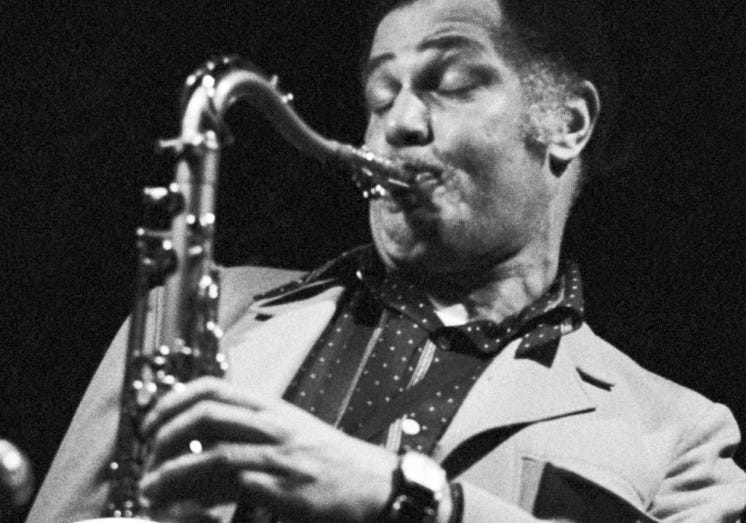
One Saturday night, I came offstage to find Dexter Gordon sitting at the kitchen table in back where the musicians gathered, a saxophone strap hanging from his neck, sucking on a reed. We were introduced; then the tenor legend unfolded himself - all six and a half feet - from his chair and walked to the bandstand. Niels and I followed.
He counted off a familiar standard tune. After a clear statement of the melody line, he began his improvisation. His invention unfolded like a Japanese scroll, one line woven flawlessly into the next, each chorus more fluent than the last. Dex, as he was called, would hang near the tonic note, vamping with his large sound, until picking up the next wave of thought and spinning another long, lucid line, rich with emotional logic. He played more than a dozen choruses. It was the most commanding jazz performance I’d heard excepting Coltrane’s in New York, which was of another order.
Dex was 36 at the time, recently released from prison in California for heroin possession, and about to take up a 15-year residency in Copenhagen with the Montmarte as his base. If Coltrane was taking his influence to the next level of possibility, Dex, a bridge from swing to bebop (such a trivial name for such a serious music, he’d say), was content to range richly within the wide standard repertoire. Musically, he was at the height of his powers. Bearing a vast musical encyclopedia inside his head, he interlaced his improvisations with quotes, allusions, and witty asides from every imaginable musical source. Neils, Petrus, and I were his rhythm section, the carpet on which he rode, and we had to be attentive and unflagging so as not to break the spell.
Offstage, Dex was witty, ironic, veiled. Even with a fresh start in clean Denmark, he hadn’t entirely licked heroin. Drug dealers from Germany would hover along the walls of the club, happy to provide. Sometimes after his solo, Dex would sink slowly into a crouch, eyes closed, until I’d wonder if one of us should rush forward and grab him before he fell off the stage. Then he’d slowly rise back up to his full height, his horn finding its way to his mouth, and enter on cue and execute perfectly.
With Dexter Gordon installed at the Montmarte, every great jazz figure touring Europe that summer - Horace Silver, Cannonball Adderly, Louis Armtrong’s band - stopped by to visit. I played with many of them. I couldn’t believe my good fortune.
That summer at the Montmarte, far from home and lost to it, I was challenged, exhilarated, happy. With barely enough money to eat, I worked every night at a strenuous level of performance with artists of supreme emotional and technical intelligence. The long days and nights of playing and listening, reading and writing, seemed like a reprieve, a wild gift, patterning a possible adult artistic life to be attained.
Word came that my drums from California were waiting down at the customs docks. I claimed them, set them up in the Montmartre basement, and began practicing with a vengeance. Each night with Dex the music rose another increment; and lurking around the club bar were other good drummers from New York, Chicago, or Paris, waiting to move in if I faltered.
I’d been playing at the Montmartre almost a month when Herluf, the owner, drew me aside and told me the piano legend Bud Powell was arriving from Paris to play the first two weeks of September, alternating sets with Dexter Gordon. Herluf wanted me to back both artists - a prospect beyond my wildest dreams.
Now i know, the great rhythm of your writing comes from those drumming days. You have lived, and are living still, the drum beats of old. What a life.
We are permanently in France or Italy...perhaps we'll meet again.