
¡XALAPA! (2)
I awoke to soft, persistent knocking. My eyes opened upon a bright trapezoid of light on the green tiles.
“Quién es?”
“Le espera un señor,” a woman’s voice answered.
I washed quickly at the cold water tap and descended the wooden stairs to the lobby. A tall, large-jawed young man in a windbreaker and sneakers stepped forward and offered his hand.
“Gustavo Servin.”
“Eduardo’s friend.”
“Bienvenido a Xalapa.”
The handshake collapsed into a Mexican abrazo - quick bear hug, paired back claps - an intimacy usually reserved for amigos, or a way of saying he was willing to be one.
We walked outside into the little plaza. Just then a wash of warm sunlight and color flooded us, diffusing the morning fog, recasting the plaza in subtropical hues. It was as if the muggy coast had risen to conquer the mountain mist. I’d never seen a faster, more dramatic weather change - from cool and drizzly to warm and tropical, black and white to Technicolor in a single dissolve.
“We live here in the mist, the llovizna, you see,” Servin said. “But when it clears, it is something, no?”
Yes it was. I followed Servin up Primo Verdad in the spreading glow, the air thick with the aroma of fresh coffee. We passed four cafes in the first block.
“From the local cafeteros, the coffee plantations,” Servin said. “There are more cafes in Xalapa than you can count. I’ll take you to one of my favorites.”
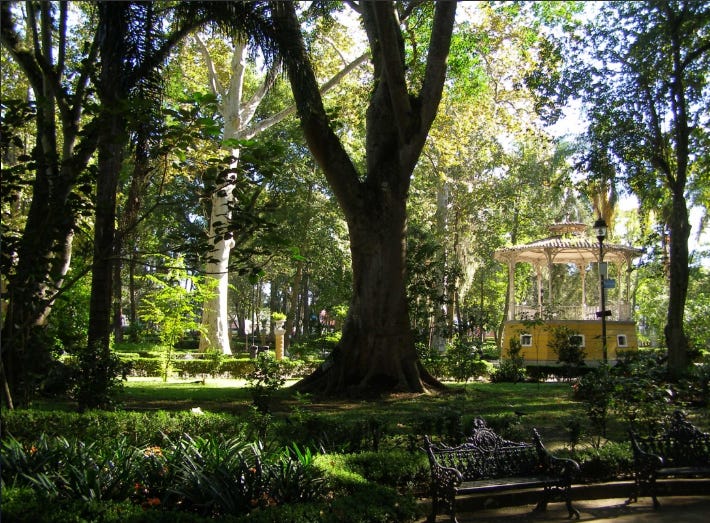
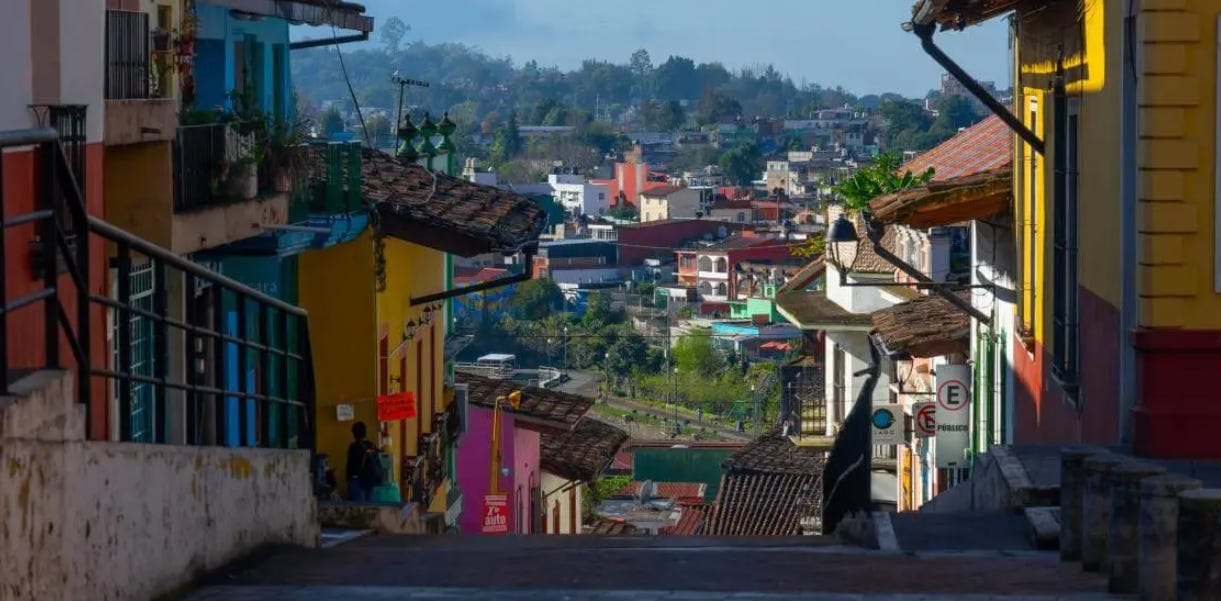
We walked along sloping cobbled streets once built for horses, past restaurants and tailor shops and chocolate stores, amid the colliding airs. Xalapa seemed to be a city of closures then sudden openings to green mountains above and valleys below. I could still read, between belching buses and morning traffic, its colonial undercoat in the Baroque government buildings and patio courtyards. Servin guided me across verdant plazas through moist parks of orchid, hibiscus, and giant araucaria, beside a lake where palms and pines grew beside each other on its banks. A silvery light, neither sun nor shade, settled around us, diffusing objects. And everywhere, the smell of fresh coffee.
“Xalapa de la feria, they called it,” Servin said. “This is where the great fairs used to be held in colonial times.”
From a parapet in the city’s central plaza, I could see that we were at the foot of the mountain the bus had descended last night in fog. Its snowy peak floated above us in a ring of clouds. Servin gestured across the valley to a sprawl of buildings and stadiums on a bluff opposite. “The University of Veracruz. Sixty thousand students. I teach there.”
I followed him down wide stairs and along another slanting street. We entered a cafe with the words LA PARROQUIA etched on its windows. Inside, white-jacketed waiters drizzled black coffee and hot milk into glasses from tin pots, proffered trays of Mexican pastries and breads amid a lively racket of conversations and clattering dishes.
Sipping my steaming lechera, I saw, two tables away, a man hunched over a book, nursing a coffee, an unlit cigarette poised in an ashtray. Strange and surprisingly pleasant, the slight smell of tobacco, the bookish scene. We could have been in Cambridge, Berkeley, a cafe in Madrid a generation ago - only the coffee was fresher and better. A literary town! I’d reached the birthplace of Carlos Fuentes.
Servin brushed sugar crumbs off his chin with his napkin then reached for another pastry. Outside, fog had moved back in, erasing sun and color as quickly as it had revealed it: “Welcome to la zona de la niebla,” he said, calling for two more lecheras.
The zone of mists. Hardly what people think of when they think of Mexico. It seemed almost perverse living in “sunny Mexico” in this way. Yet the cool drizzle lent Xalapa a dreaminess, softening hard edges, inviting contemplation. My temples pulsed from the dense, steam-infused coffee.
“Think of Xalapa as Mexico’s San Francisco. Or Seattle,” Servin said, as if reading my thoughts. “Coffee, rain, the life of the mind. Poets love it, and musicians - we have our own symphony orchestra - and crazy architects like me. But when the sun comes out, it’s a hot, tropical sun. And then if you like, an hour down the road you are swimming in the Caribbean.” Servin gazed at me. “So will you be in Xalapa awhile?”
“I’m planning a few trips in the region. Veracruz of course. Up the coast to Papantla. El Tajin, to see the ruins. The son jarocho festival in Tlacotalpan.”
“Yes you must go. And then?”
“The Yucatan. Possibly Chiapas.”
“Sounds intriguing. But listen. I have a little house to rent, if you’d be interested.”
“Thanks, I don’t think so. I’ll be traveling about, and…”
“It might be cheaper for you. You need a base somewhere. Why not Xalapa? How much is the room at the Hotel California?”
“Eleven dollars a night.” Hardly a back-breaking figure, even in Mexican terms.
“I can offer you my casita for two hundred dollars a month. You’d have more room. A kitchen, privacy. Shall we take a look? It’s right around the corner.”
Halfway down a plummeting street called Sebastián Camacho, Servin opened the padlock on a tall white metal gate. We climbed brick stairs slippery with green mold from Xalapa’s unremitting damp, passed a low empty structure on our right. At the top we came to a small ruined garden, an old metal table and chairs sitting lopsided among creepers and wild orchids. Morning glories twined up the remains of a broken wall dense with patches of flaking pigment. Beside the garden stood a small, ocher-toned casita.
Inside it was clean, and freshly painted white above and deep yellow below at the faldón, the waist-high dividing line. There was a wide mattress with bedding, a simple bare desk and chair, a gooseneck lamp. The kitchen had a cold water sink, tile counter, minifridge and hotplate, and in the bathroom a rudimentary shower, toilet, and covered bucket, as Mexicans don’t flush their tissues. A window in the front room framed a perfect view over Xalapa’s rooftops of Citlaltépetl, the snow-capped mountain we’d seen from the plaza.
It was sweet, monastic - beautiful.
“You could take it for a month. Then we’ll see, no?”
Back at the corner of Xalapeños Ilustres and Primo Verdad, the sun reappeared, throwing up a rainbow directly in front of us, tilting the landscape and mood of the city once again.
“So where will you go today?” Servin asked.
“Explore the city a little. The anthropology museum for sure.”
“Yes, you must see the Olmec heads. But there’s more.”
We arrived at the little plaza in front of the Hotel California. Looking up, I could see now it had a whitewashed facade, red trim, and black iron balconies. Servin handed me his card. “Give me a call later. Tell me what you decide.”
“Thanks, Gustavo. Honestly, I doubt I’ll take it.”
“Sí, pero…” He spread his hands and wriggled them in the Mexican gesture of equivocation.
“What?”
“The Hotel California. You know what they say. You can check out but you can never leave.”
I laughed at his command of the reference. It was near impossible to visit a country without hearing that song. “Wherever you go,” I said, “there’s The Eagles. Why?”
“It’s a mystery,” Servin said, clapping me on the shoulder. “Hasta pronto, eh?”
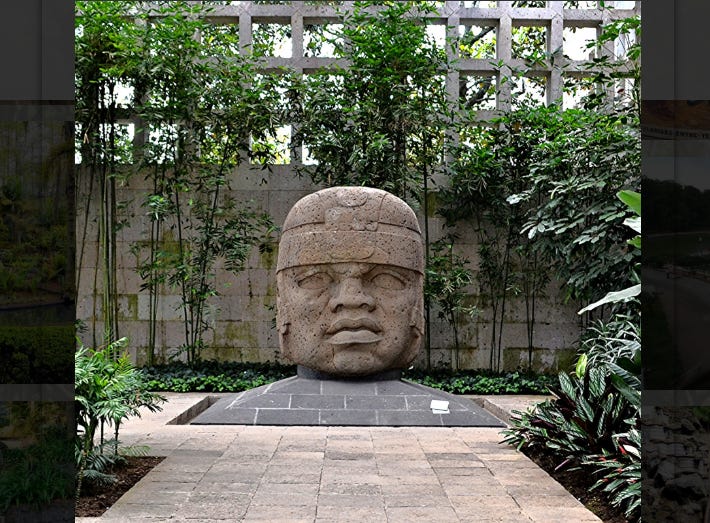
They always look so forbidding in photos, those massive Olmec heads - impassive, unpitying, eyeless but staring straight at you. Everybody’s seen them in reproduction on the covers of tourist books or museum catalogs. Face to face with them, here in Xalapa’s modern, plant-thronged Museo de Antropología, they seemed absolutely huge, more than twice my size in height, as wide and thick as they are high. How did the Olmecs get these stone colossi up the mountains from southern Veracruz a thousand years before Christ?
But seeing them up close from the side and back, not just the frontal view on the book covers, these pitted basalt giants, with their squashed wide faces, flat noses, and thick fluted lips, looked almost benign, friendly even - smiling slightly, sagely. Pre-Columbian peoples, usually portrayed as deadpan, must have laughed a lot if these heads, and the thousands of little pinch-pottery figurines in the museum’s Huastecan collection, are any indication. But they did look so African, the big ones. I could see how a heretic German-Mexican anthropologist, Alexander von Wuthenau, used them as evidence pointing to migrations from West Africa to the Veracruz coast long before the Spaniards came, suggesting African traces in the coastal population predating slavery.
Mexico’s layered, orate history, still only partially decoded, sometimes seemed such rich terra incognita to me, coming as I do from the nation to the north, where history and memory are deleted daily; and living here seemed less an odyssey in an exotic foreign land than simply a chance to fill out the rest of my American self.
I spent midday exploring Xalapa’s tangled central streets and lanes, ducking into quirky museums and bustling markets, pausing for another lechero in another café. Walking the serene lake path below the hilly green campus of Veracruz University, I knew I was already falling in love a little with Xalapa.
At some point I realized I hadn’t seen any foreign tourists. In one of the half-dozen bookstores along Xalapeños Ilustres, I asked for a Xalapa guidebook and was told none exists. “Cool, clean and civilized” was Lonely Planet’s brief verdict on the city. Six hours by car or bus from Mexico City, with no real airport, far more cafés than cantinas, and weather like this, Xalapa was hardly the place to party or work on your tan. Even the spelling of the city’s name was unsettled, with its optional X or J.
As if to bring home the point, I went to a modern building across from the Parque Juárez in search of the tourist office. I found it upstairs, at the end of a dim corridor, a bucket and mop leaning up against a locked door with a frosted-glass pane that said in fading letters OFICINA DE TURISMO.
On Calle Diamante, one of Xalapa’s little pedestrian streets, I had lunch at a restaurant called La Sopa and thought again about the casita Servin had shown me.
Just what I need, I thought: another house. I wasn’t a land baron, just a writer with a bad case of wanderlust. Still, $200 a month was the price of a few meals out with friends in New York or L.A. Servin was probably right that I’d save a little money by taking it. A point of departure for journeys into the region and beyond?
No, I didn’t really need it. At first sight, the ruined garden and soft yellow walls had set off a tremor of delight - evoking the romance of youthful travels in southern Europe, or student days when I lived only with books and ideas, presentiments and possibilities. Then there was the view of Citlaltépetl from the window over the desk.
A spot from which to consider the world anew. A place to plant my feet in between voyages as the world refigured itself around me.
I took out Servin’s card and looked at it.
Mornings when I’m here, I wake up, walk outside, and ignite the pilot of the old calentador. Sometimes the drizzle, the chipichipi, extinguishes my Perla wax matches one by one, until finally, on my last strike, it lights. I brew a cup of indescribably strong coffee from nearby Coatepec and take it out into the ruined garden. Then I lower myself into one of the rusted metal chairs, among the orchids and morning glories and broken walls, to wait for the shower water to heat up. I watch the sun burn away the mist, turning the casita walls a rich gold, illuminating the snowy volcanic peak; then, after a bow to the shade of Malcolm Lowry, I go inside for my shower.
There's a La Parroquia in Xalapa now, but I suspect it isn't the same place. I think I had lunch there. However, I went to two cool places in Veracruz that fit this description, the Gran Café de la Parroquia and the Gran Café del Portal. I hold the opinion that Veracruz is underrated.
I also made a side trip to Coatepec, and for coffee drinkers, that's worth doing.
Marvelous…so glad the house is now the character, too? I can smell the cofffee….