
VISIT TO A RANCHO

One September evening, Álvaro, a new friend, stopped by to take me to a fiesta at a communal ranch outside of town. A thoughtful, delicate man with limpid brown eyes and a gray mustache, Álvaro grew up in the California lettuce fields and worked with César Chávez’s farmworkers’ movement before coming to Mexico to teach printmaking at the Bellas Artes Institute.
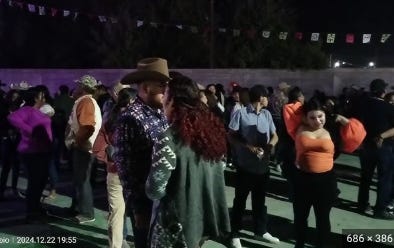
A few miles above town, he wheeled his Ford pickup onto a dirt road, passed through a low open gate, and parked in a clearing beside a barn. Stepping out, I smelled hay, animal feces. Horses were tethered to the barn, pigs and chickens roamed freely. Short, brown men milled about in clean cowboy outfits, women in bright dresses. A boy shot off flares in the clearing, summoning people from the surrounding ranches. There was an open fire and a table with beer and tamales.
More people arrived, greeting each other with quiet gentility and the soft handshake Mexican men use. “The fiesta will go all night,” Álvaro said. “This has nothing to do with the national patriotic celebrations. It’s about the harvest. Most of these guys go to Texas or California twice a year to work, then they come home for spring planting and fall harvest.”
“But they have land here. Why go?”
“These are ejidos, small plots given out to peasant farmers after the 1910-1920 revolution broke up the big land holdings. It’s below subsistence. Small farmers still can’t get loans or decent machinery. So they pay a coyote and make the trip across the border. They’re branded criminals for entering the States illegally, even though the American bosses welcome the cheap labor.”
The campesinos talked softly among themselves beside the barn. I visit their country by choice; they visit mine because they have to. Here in Mexico I come to know the places that fill their dreams when they’re lying in a Texas bunkhouse, washing dishes in Chicago, bending over a hot central California strawberry field, the families they long for on the other end of a phone line.
On a wooden platform stage built against the back of the barn, men and women began a slow, circling dance to their own singing accompaniment. There were no instruments. The dancers repeated the lines of the song again and again, moving in the same shuffling circle. The singing was out of time, the dancing awkward: This was not the Ballet Folklórico. Yet everyone seemed to know what to do. The near-tuneless, six-line Spanish ditty was oddly haunting, entering my head and lodging there. Something about corn and the moon, but so encoded in idiom I couldn’t sort it out. Neither could Álvaro. It appeared neither glad nor sad, this song, but empty of readable emotion entirely. The performers’ expressions were blank, deadpan, as were the gathering audience’s. When their performance stopped, or petered out from time to time, there was no applause or recognition. Yet Álvaro assured me this was a festival celebrating the corn harvest and everybody was happy.
I thought of D.H. Lawrence’s troubling description of indigenous dancers at Lake Chapala, tamping the earth again and again, and his charge that the people had no developed consciousness and lacked the spark of reason. Mexico had overwhelmed the fussy, neurasthenic Lawrence, who deified the primordial but was skittish at the slightest encounter with it. In Mexico City he fled the bullfights in horror. He described serene indigenous babies as being flat-eyed and dull. Aldous Huxley’s Mexican writings read similarly, as do Graham Greene’s: full of distaste for the heat and dirt and dust, the untamed sights, smells and customs. Paul Bowles discerned in prehispanic life the same maw of emptiness he found in the Maghrebi deserts. Strange, the judgments of these Western writers about a people who’ve constructed ornate languages, vast cities, systems of mathematics and astronomy; who can be so graceful and sensitive in their human relations; whose extravagant, ironical arts speak volumes about existence. Cartesian reason is confounded by what it finds here. Watching the ritual dance, I thought how gringo commentators often fail to grasp what Pascal surely meant when he said, “The heart has its reasons that reason does not know.”
The celebrants carried on the tireless dance, undisturbed by sprinkles of rain that drove us under a pepper tree, a pirul. It will go like this until dawn, Álvaro said, only drunker. Finally we climbed back in the truck and left the ejido ranch.
Back in town, Álvaro pulled up on Calle Insurgentes before a makeshift stand outside the Oratorio Church, where an aproned woman ladled hot corn atole drink from a metal pot into ceramic cups, handed us steamed chicken tamales on paper plates.
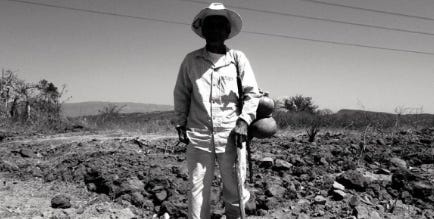
Alvaro pulls us into the mystery that these Anglo writers, at least some, sought. But when confronted with it, they recoiled, some in disgust (Lawrence, Huxley). What did they fear? Perhaps seeing that very primal element in their own being.
It is possible to enjoy a culture without understanding it. Sometimes, the understanding undermines the enjoyment.