
TRAVEL FRAGMENT
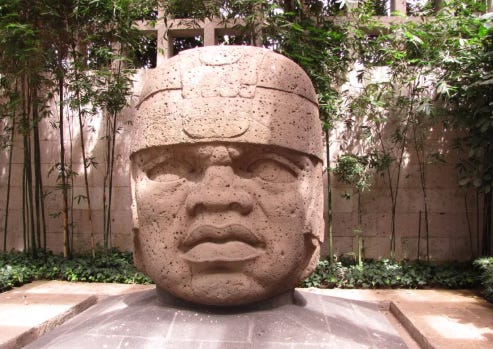
They always look so forbidding in photos, those massive Olmec heads - impassive, unpitying, eyeless but staring straight at you. Everybody’s seen them in reproduction on the covers of tourist books or museum catalogs. Face to face with them, here in Xalapa’s modern, plant-thronged Museo de Antropología, they seemed absolutely huge, more than twice my size in height, as wide and thick as they are high. How did the Olmecs get these stone colossi up the mountains from southern Veracruz a thousand years before Christ?
But seeing them up close from the side and back, not just the frontal view on the book covers, these pitted basalt giants, with their squashed wide faces, flat noses, and thick fluted lips, looked almost benign, friendly even - smiling slightly, sagely. Pre-Columbian peoples, usually portrayed as deadpan, must have laughed a lot if these heads, and the thousands of little pinch-pottery figurines in the museum’s Huastecan collection, are any indication. But they did look so African, the big ones. I could see how a heretic German-Mexican anthropologist, Alexander von Wuthenau, used them as evidence pointing to migrations from West Africa to the Veracruz coast long before the Spaniards came, suggesting African traces in the coastal population predating slavery.
Mexico’s layered, ornate history, still only partially decoded, sometimes seems such rich terra incognita to me, coming as I do from the nation to the north, where history and memory are deleted daily; and living here seemed less an odyssey in an exotic foreign land than simply a chance to fill out the rest of my American self.
I’d spent midday exploring Xalapa’s tangled central streets and lanes, ducking into quirky museums and bustling markets, pausing for another lechero in another café. Walking the serene lake path below the hilly green campus of Veracruz University, I knew I was already falling in love a little with Xalapa.
At some point I realized I hadn’t seen any foreign tourists. In one of the half-dozen bookstores along a street called Xalapeños Ilustres, I asked for a Xalapa guidebook and was told none exists. “Cool, clean and civilized” was Lonely Planet’s brief verdict on the city. Six hours by car or bus from Mexico City, with no real airport, far more cafés than cantinas, and weather like this, Xalapa was hardly the place to party or work on your tan. Even the spelling of the city’s name was unsettled, with its optional X or J.
As if to bring home the point, I went to a modern building across from the Parque Juárez in search of the tourist office. I found it upstairs, at the end of a dim corridor, a bucket and mop leaning up against a locked door with a frosted-glass pane that said in fading letters OFICINA DE TURISMO.
On Calle Diamante, one of Xalapa’s little pedestrian streets, I had lunch at a restaurant called La Sopa and thought again about a small casita an architect friend, Servin, had shown me that morning.
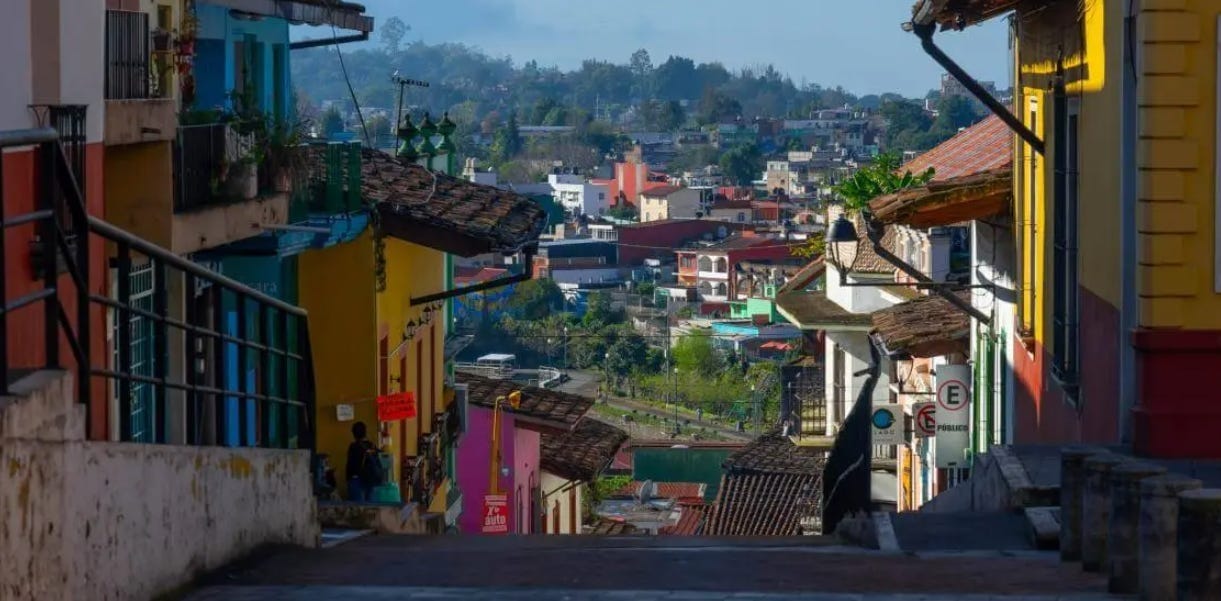
Halfway down a plummeting street called Sebastián Camacho, Servin had opened the padlock on a tall white metal gate. We’d climbed brick stairs slippery with green mold from Xalapa’s unremitting damp, passed a low empty structure on our right. At the top we came to a small ruined garden, an old metal table and chairs sitting lopsided among creepers and wild orchids. Morning glories twined up the remains of a broken wall dense with patches of flaking pigment. Beside the garden stood a small, ocher-toned casita.
Inside it was clean, and freshly painted white above and deep yellow below at the faldón, the waist-high dividing line. There was a wide mattress with bedding, a simple bare desk and chair, a gooseneck lamp. The kitchen had a cold water sink, tile counter, minifridge and hotplate, and in the bathroom a rudimentary shower, toilet, and covered bucket, as Mexicans don’t flush their tissues. A window in the front room framed a perfect view over Xalapa’s rooftops of Citlaltépetl, the snow-capped mountain we’d seen from the plaza.
It was sweet, monastic - beautiful.
“You could take it for a month,” Servin said. “Then we’ll see, no?”
Just what I need, I thought: another house. I wasn’t a land baron, just a writer with a bad case of wanderlust. Still, $200 a month was the price of a few meals out with friends in New York or L.A. Servin was probably right that I’d save a little money by taking it. A point of departure for journeys into the region and beyond?
No, I didn’t really need it. At first sight, the ruined garden and soft yellow walls had set off a tremor of delight - evoking the romance of youthful travels in southern Europe, or student days when I lived only with books and ideas, presentiments and possibilities. Then there was the view of Citlaltépetl from the window over the desk.
A spot from which to consider the world anew. A place to plant my feet in between voyages as the world refigured itself around me.
I took out Servin’s card and looked at it.
*
Mornings when I’m here, I wake up, walk outside, and ignite the pilot of the old calentador. Sometimes the drizzle, the chipichipi, extinguishes my Perla wax matches one by one, until finally, on my last strike, it lights. I brew a cup of indescribably strong coffee from nearby Coatepec and take it out into the ruined garden. Then I lower myself into one of the rusted metal chairs, among the orchids and morning glories and broken walls, and wait for the shower water to heat up. I watch the sun burn away the mist, turning the casita walls a rich gold, illuminating the snowy volcanic peak. Then, with a bow to the shade of Malcolm Lowry, I go inside for my shower.
Oh, your wanderlust life about which so many of us knew zilch...such a delight to find out about it now when my appreciation of such things is far more developed than in the late 60s... haha.
Magical!