
RESTLESS FIESTA

Moving through time and space, we invent fictions to propel ourselves into fact. The reasons for things often turn out to be other than they first appeared. A journey - and what isn’t a journey? - picks up a narrative of its own. The map we set out with turns out to have been a figment, a fraud, a useless scrap of paper.
The fact was that I no longer knew why I was out there traveling. I was out there because I was out there.
In the grips of a pleasurable indefinition, floating in a brine of uncertainty, all notions of family, nation and work had become fluid, conditional. That seemed to me an entirely appropriate state, matching reality. I felt like I could carry on like this endlessly, moving from place to place. If there was some pathology at play (or at work), it struck me more as a solution than a problem. “Episodes of sudden, unexpected and purposeful travel from home,” in the words of the Merck medical manual. If “dissociative fugue” was flight away from, this felt more like flight towards some ever receding horizon. My wanderlust had picked up a momentum I couldn’t seem to arrest, and I didn’t care.
Arriving back in Xalapa after a trip to the Mayan Yucatan, I could only think of the Greek poet C.P. Cavafy’s lines, in which he counsels Homer’s Odysseus:
When you set out on your journey to Ithaca
Then pray that the road is long
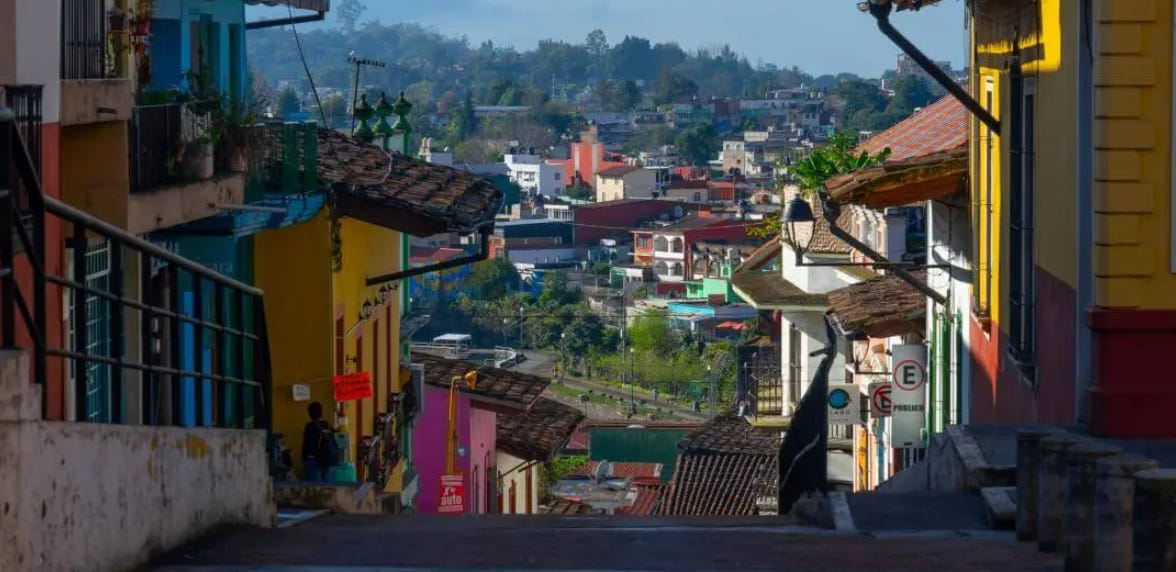
The taxi ride through drizzle reprised my first arrival - along Xalapeños Illustres, past the street called Primo Verdad and the turnoff to the Hotel California, down steep Sebastián Camacho to the iron gate of the little yellow house I’d rented. As I hauled my bags up the stairs, the mist suddenly cleared, in that shape-shifting way of Xalapa weather, revealing a fat, full moon above. I heard music playing somewhere. Exultant to be back, eager to taste silence and solitude again, I passed the main house and turned the corner to the casita.
Gustavo Servin, architect, new friend, and landlord, was standing in the ruined garden with a crowd of people, laughing and talking beneath paper lanterns. There were tables of food and drink. Sade’s “Smooth Operator” wafted from a portable CD player.
¡Qué milagro! Welcome back!” Gustavo called, rushing forward to enfold me in an abrazo. “It’s my birthday. We’re having a little fiesta. Put your bags down and come join us.”
“Sí, gracias,” I murmured.
I opened the casita door, flicked on a light, and set down my bags. The yellow house looked as I’d left it but for dust, a few cucaracha corpses, and the strong aroma of mold. I opened the shutters over the desk to find the view to the volcano Citlatépetl now interrupted by party lanterns.
No chance of sleep for a while, let alone rest. Mexican sociability, to a visitor from the privacy-obsessed Protestant north, has its strained moments. The fact that I paid rent, however modest, to Victor for this place might have dissuaded a U.S. or European landlord from having a party in my garden. But when you’ve grown up in a swarming Catholic household, what’s a little noise and proximity among friends? To put on a sour face would be further evidence of the tight, unflowing mien North Americans are often accused of bearing. If I’d found many habits in Mexico easy to adapt, even preferable to our own ways, brushing aside the sense of personal invasion was one of the hardest for a gringo, even after years at it. With little choice but to join the fiesta in progress, I walked outside into Gustavo Servin’s garden party.
Servin introduced me around. “This is Marisela, an architect who teaches with me at the university. She made the mole. Juan Carlos, who has a great new restaurant.”
“Hola. Mucho gusto.”
“Encantado.”
There was a young artist, Alicia, who seemed to be Servin’s girlfriend; Ofélia, an “actress and midwife,” and her husband Martín, a sculptor who spoke French to his son. All of them seemed curious as to why I was in Xalapa. “The weather,” I tried to jest, which invariably elicited the term chipichipi in response.
Servin’s party could have been in San Francisco or Austin or Paris or Buenos Aires. At a certain level of education and economic life, global culture had become generic. Pasta salad, French bread, chicken with mole sauce, guacamole. Beer, tequila, wine. Mostly American and British pop. Even the rebozo draped around the shoulders of the Mexican actress/midwife could have been seen at a party in Berkeley or Tokyo. Servin’s friends were the cool, professional artistic people of Xalapa.
The chipichipi returned as quickly as it had dispersed - a blast of frio, fog and drizzle, turning us into soggy ghosts, shifting the conversation and rescuing me. I bid my goodnights, wished Servin another happy birthday, and headed for my casita.
The fiesta continued a little while longer until the drizzle became a shower. The last thing I remember before sleep finished me off was Whitney Houston’s “I Will Always Love You” abruptly aborting, leaving only the kinder music of Xalapa rain on my roof.
By the next morning, the rain had wiped the sky clean. I stood in the middle of a bright green bowl of high tropical valley. Out the window above the writing desk, beyond the paper lanterns and soggy party equipment, hawks and zipolotes banked against a hard cobalt sky, then glided across the mountain face in silvery light. The grand, snowy volcano was there to greet me.
So was mold - green, dank, dusty fungus that in my absence had invaded clothes, bedding, towels and sheets. It had sprouted in the wicker canastas where I’d left clothes, the unpacked suitcase, the suitcase itself. Green lichen crept up the base of the interior white walls. Little in the casita had escaped Xalapa’s relentless damp.
I took the clothes and bedding out into the old garden, spread them along the wall ledge in the sun, and began beating them with a broom handle, choking among clouds of green dust. If this didn’t work, I’d have to buy new clothes and blankets. Here, I thought, was the down side of chipichipi.
Back inside, I emptied my shoulder bag of travel stubs and receipts, notebooks and papers. I spread out my writing things at the desk. Then, as a hotplate severely narrows one’s options, I jotted down a few elemental provisions: eggs, chorizo, chiles, pasta, tortillas, bread, onions, garlic, milk, yogurt, and of course coffee. Locking the casita door behind me, I took the slippery stone path down to the street and hiked up Sebastián Camacho to the centro.
At Café La Parroquia, where Servin had first introduced me to the lechero, I sat among clattering dishes, heavy-lidded intellectuals bent over tomes, and tables of valise-toting businessmen plotting the day’s moves. A waiter in a white jacket streamed hot milk from a metal pitcher into my glass of black coffee, giving teeth to the word infusion - not unlike the mint tea ritual in a Moroccan cafe. The effects of a second lechero sent me bounding onward to the open coffee counter at Café Colón on Primo Verdad where, clothed in the scent of the bean that sustained the region, I bought a kilo of a dark blend for the house’s little espresso maker.
For the next several days, I stayed in the yellow house and wrote. Morning sun and successive beatings with the broom handle rescued most of the bedding, and some socks and shirts, from the green powdery mold, but not two pairs of shoes, pants, and a suitcase.
Each morning I walked out into the creeper-clogged garden, a mug of Xalapa coffee in hand, lowered myself into a sagging chair, and saluted snow-ringed Citlaltépetl. Then invoking the shade of Malcolm Lowry - who after writing perhaps the best Mexico novel in English, Under the Volcano, died stupefied by drink and pills - I arrayed the journeys of recent months about me like so much footage and set to work.
(Adapted from the travel narrative Mexican Days (Random House))
Makes me want to pack up and head back to Mexico. I feel like I’m right there. Sneezing from mold, kissing the cheeks of friends, drinking tequila or coffee. Sigh. I miss it. So will go read your beautiful book again. Gracias!
So rich, this espisode, so easy to see and be in, the smell of the coffee...the moid...the party. Rich, rich, rich writing.