
PALENQUE
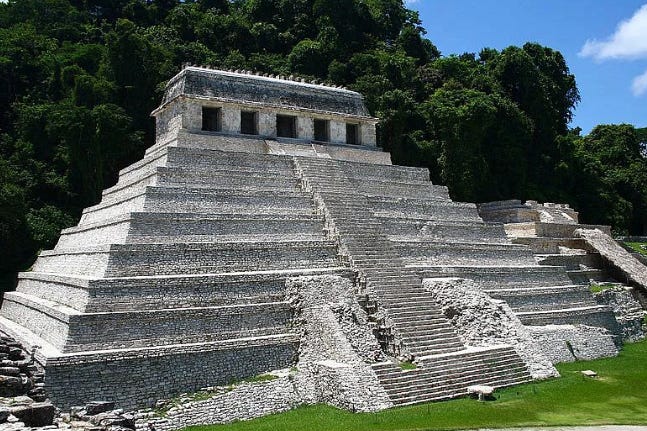
(Excerpted from my novel THE BATS)
IT WAS SEMANA SANTA, spring break. She was twelve, and her father had brought her along to Palenque to translate where his Spanish was lacking. He had come to shoot a new inscription find, the last step in a project for INAH, the Mexican anthropological agency, documenting Mayan sites in southern Mexico. The money he was to receive was already spent on the satchel of restoratives he now carried with him everywhere.
Liana heard her father rattling around in the hotel room next door all night, muttering to himself. That morning he burst into her room when she was coming out of the shower.
“Come on, Lia. I’m going to show you something.”
She would have been content to stay in the little air-conditioned hotel, feeding the caged toucan and watching Mayan women in indigenous dress reading the daily news on TV in Tzotzil. But she knew that when her father got like this you didn’t stand in his way.
They bumped through the rutted early morning streets of Palenque Town in the mud-caked Land Rover, past women from the highlands in their colorful huipiles, folded woven scarves on their heads. “They still speak Chol on the streets here,” Peter said excitedly. “The descendant of Cholan, the language you see in the inscribed temple texts.”
He sped up the winding jungle road towards the site of the ruins, his fingers knotted around the wheel.
“Why are we going back here again?”
He just nodded and grinned, his jaws grinding.
In fact it had been a little bit thrilling being with her father on this trip. Peter had seemed in his element. She felt his passion and mastery, his wide learning and skills. His flowing mane going white now, he appeared the magnetic director of theater and film she’d been to young to know.
Threads of mist twined along the Chiapan hills, the air already warming. Liana rolled down the window, watched Mayan farmers level grass fields with machetes.
“Writing is speech made visible, Liana. Started with the Sumerians 5,000 years ago, the Egyptians right behind them. Later, these we call the Mayans.”
He pulled into the forested parking area at the top of the rise and spun to a halt beneath a tree. He tipped a trinket seller to watch the Land Rover then bounded off, light meters and a heavy-duty Eveready flashlight dangling from his flak jacket. Liana hurried to keep up.
The short, steep climb brought them to Palenque’s wide, grassy plateau and the first three visible structures, set aside each other against a hillside of dense forest. They overwhelmed all human presence.
The Temple of the Inscriptions, where Peter had done most of his shooting, was beautifully intact. Pyramidal, with steps leading up the center, it divided into eight platforms as it rose some seventy feet, framed against steep forest, to its summit: a roofed, six-columned, limestone pavilion.
Peter stood before it transfixed. “The most beautiful structure I’ve ever seen,” he said softly.
She thought it pretty too. In her schoolbooks, Mayan temples appeared stony and cold, geometric monoliths bereft of the colors that once covered them, but this alabaster marvel breathed harmony, purity, proportion. Inside the upper pavilion, Peter said, paneled murals bore inscriptions narrating the city’s history - its rulers, its divine origins – and the 617 glyphs he had been shooting.
“King Pakal is buried here,” she said. “We learned about in school.”
“You’re a smart cookie.” He put his big arm around her and squeezed her shoulders. “He ruled for sixty-eight years, a golden age.”
She gazed up its sixty-nine stairs where two days earlier a tourist had toppled to his death. To die is to “enter the road,” the Mayans say. Liana, watching the poor lifeless man being borne away on a stretcher, had wondered if the road he was entering was any more than the winding two-lane stretch to the cemetery outside Palenque Town.
“The entire temple was built as a conduit to the afterlife,” Peter said, with a sweep of his arm. “But that’s not what I want to show you, Lia. Come.”
She trailed him across the park-like agora. The heat was turning fierce. Peter ducked through a sprawling warren of arches, niches, platforms, courtyards and murals known as The Palace, then veered right and disappeared into the forest wall itself.
She followed him up stone steps through dense trees then continued along a narrow trail. The air was cool and damp, the light dim. There was nobody in this corner of Palenque, no markers on the path. “It’s spooky here,” she called.
“Turn and look.”
They were high enough to see back across the green forested plain that ran all the way to the eastern coast of the Yucatán. The tips of smaller edifices not yet named but only numbered jutted above the level forest.
“Uncountable cities,” her father said, “spread across four countries. The chicleros, the gum harvesters who work the forests, keep finding more. All built out of rock and limestone and mortar.” Liana saw below them the shining, sun-washed upper platform of the Temple of the Inscriptions, with its stone narratives. She understood enough to know that this was Palenque’s true magnetic center - what had obsessed the explorers, the linguists, the anthropologists, and now her father.
They climbed further until, swallowed by foliage, they couldn’t see the flat expanse they’d left, or anything beyond the forest they were in.
“Are we almost there?”
Peter turned, red-faced, too winded to speak. He pointed ahead to a set of narrow, broken stone stairs, coated with wet leaves and moss. Clutching gnarled vine roots for support, they began to climb. She couldn’t get a grip with her sneakers. Peter reached out and pulled her to the next step.
“Lean in, Liana. Remember that man who fell.”
Reaching the top, they scrambled onto the floor of a roofed stone pavilion.
“Edificio XIX,” Peter said. “Discovered only last year. A rare creation myth sequence. We’ll be shooting it this afternoon. Then they’re going to move it to a museum.”
Her father was weaving. He stank of alcohol and sweat. She moved to steady him.
“Do you see how light barely penetrates these temples, even when the sun is high? The murals and inscriptions would have lain in darkness.”
They dropped onto their knees and peered under a ledge.
“This frieze will be brightly lit and easy to see when it’s transferred to a museum. But look how they positioned it, Lia. They would have needed torches to see it.”
She could just make out Mayan figures - warrior kings, nobles, servants - and the blocky, complex glyphs she’d come to recognize as Mayan writing.
Peter turned on the flashlight. Slowly he began to rake the panel with light, section by section.
It was a long, horizontal frieze of extreme drama and beauty. The mural seemed to move, the figures leaping into motion as the light crossed them.
“You come into this shaded pavilion. You sit and wait in the dark, expectant. Then the pictures are lit, the story is revealed.” Her father peered at her. “What does that remind you of, Lia?”
“The movies.”
“That’s right. The Mayans went to the movies. At least the priests did.” His great haggard head was lit from below now by the flashlight, a bloody-eyed ghoul. “The stone figures came alive by the flame of the torch.”
He turned off the flashlight. The darkness was absolute. Frightened, she reached for his arm and held it.
“The movie is over,” Peter said.
Moisture dripped onto the wide fronds, the stones. The frieze had lain invisible for twelve hundred years.
In that moment at Edificio XIX Liana glimpsed something of what her father was about, what drove him through photography, theater, cinema, and the film he longed to achieve. Some mad attempt to renew the creation of the world. It terrified and excited her.
*
The following morning she heard Peter bellow her name from the next room. She found him trembling and shirtless on the edge of his bed, his bloodshot head hung down, a mezcal spilling from his hand. “My feet. I can’t feel them.” She’d never seen him this bad. Outside, a driver waited to take them to Villahermosa and their plane. “Help me, Liana.” His medicine satchel lay open next to him, a strew of needles and vials. He pointed to one. “Just do it. Stick it in.”
She found a maid to bring a tub of hot water and then she rubbed his feet.
She wanted this vacation to be over. Her father worried her, his passions were not hers. She didn’t care about the ancient Maya in the same way. She saw that her father was veering out of control, that it would get worse, and that it would fall to her to protect herself and her brother.
She saw too that the great ruin her father had exposed to her was himself.
Am getting The Bats.....wow...
This story engaged me, Tony. Makes me want to read The Bats if I can find a copy.