
JOURNEY'S END
(Another re-post, updated, this one from November 2023. As with last week’s, offered in the light of current US immigration policies.)
Much of the best travel writing is to be found in novels. Graham Greene’s The Quiet American, to choose an example, renders Vietnam during a particular era hauntingly, indelibly. My novels tended to be full of travels, so it was odd, perhaps, that the book of mine that turned me into a “travel writer” was a memoir about arrival, finding a home. The fact that the place was in another country must have marked it as “travel.”
Its success afforded a break from the struggles that attend fiction. Travel magazines sent me to countries I was happy to write about: Morocco, Myanmar, Vietnam, Bolivia, Peru, Mexico. It was nice to speak on the page in my own voice. I taught for several years at a travel writers’ conference. I wrote a memoir of new journeys around Mexico. There were readings, tours, reviews, interviews.
What remains most vivid to me about those travel writing years, though, is an episode that occurred near their end.
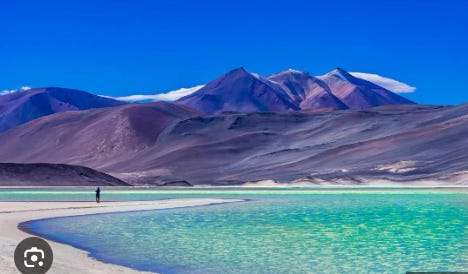
A 27-hour, 1,000 mile bus ride up the Chilean coast from the capital, Santiago, had landed me in San Pedro de Atacama, a small oasis town in the middle of vast desert and salt flats. It was already after dark, and tired, sore and hungry, I wandered the town’s several main blocks looking for a place to eat.
I passed modern bars and restaurants with large screen TV’s. Sade and Lenny Kravitz pulsed out of big speakers. Menus were written in Spanish and English. Blinking signs for Heineken, Amstel, Corona revealed mochileros, backpackers, from around the world in black jeans, tank tops and tattoos, sitting at tables and bars. The discomfort of the familiar began to seep in. It seemed I’d landed in some global watering hole.
Failing to find any place offering regional or Chilean food, I chose one of the contemporary restaurants. Only after I’d ordered did it occur to me that it was the same meal I’d eaten at a restaurant in California a week earlier, the night before departing on this journey. Hunkered over my arugula salad, fettuccini alfredo, and vino tinto, I realized I was in a travel corridor. I could have been in Berkeley, Amsterdam, Bangkok, Los Angeles. The end of my trip mirrored and recapitulated its beginning.
On the way to LAX, I’d seen a billboard showing a man floating in a rubber raft in a hotel swimming pool, a mobile phone to his ear. It said, “With AT&T, you’re never out of touch.” But what if you want to be out of touch? Getting lost was becoming near impossible. There was no longer a faraway place. You had a better chance of encountering the unfamiliar in an ethnic neighborhood other than your own in the town where you lived. McLuhan’ś global village was reality now, but it looked less like a village than a mall. I was on a journey to nowhere.
(Note: A Google search today tells me that there are 720 Airbnb listings in San Pedro de Atacama, population 4,000.)
Sunk in my thoughts about this, I wondered too if elective travel, journeys for the sake of just going there, let alone writing about them, hadn’t become gratuitous when countless numbers of migrants were forced into perilous journeys to escape persecution or poverty. While I traveled south to write appreciatively of what I saw, tens of thousands were driven north from their homes to brave hunger, thirst, drowning, kidnapping, and most likely rejection at the border of their destination. These were today’s adventurers, not the mochileros.
Yet my young travels, incited by books, had meant so much, had in effect formed me. Writers who traveled brought fresh perspectives, news of the greater world, antidotes to provincialism. Marco Polo’s Asia, DeTocqueville’s America, Jean Rhys’s Paris. Ultimately, as the writer Pico Iyer has noted, we travel in search of ourselves. In the Atacama desert that night, something had changed.
Several months later, the editor of a major travel magazine invited me to write an article on the burgeoning Mexican resort area south of Cancun, newly dubbed the Riviera Maya. I turned her down. After that, we lost interest in each other, and me in “travel writing”. Gradually I reentered the wilds of fiction, where you’ll often find me these days.
This isn’t to suggest that, if offered the chance to fly to, say, Paramaribo and write about it, I’d refuse.
Tony, I’ve missed you. just finished you thoughts on not finding the authentic un travel place. It occurs to me it might be be right here near Leones as we drive along the Panaramica, not Paseo de La Presa. abrazos Sterling
Our friend, Michael Mewshaw, was a friend of Graham Green, and yes, love his travel writing along with H. V. Morton in Italy. Gone are the days, but you do an awfully good job of it. I read one sentence to my honey and he said, "He's very very good. Wow!" I looked up the little town and it is charming,..still, I hope.