
GOLDEN LAND
From the 10 freeway heading east, the L.A. basin, swept clear by an offshore breeze, looks crystalline and sharp. The flatlands to the south are visible all the way past the airport to Signal Hill. North along the run-up to the Santa Monica Mountains, the silvery palm branches shimmer like streamers and the low stucco buildings look fresh-scrubbed in the morning light. Ahead, Mount Baldy’s distant snowy peak appears as close as a hood ornament.
This light, diffusing through what William Faulkner once called the “vague high soft almost nebulous California haze,” aroused in him, and most writers who came here, a sense of menace. The painters, though - Hockney, Diebenkorn, Ruscha - reveled in it.
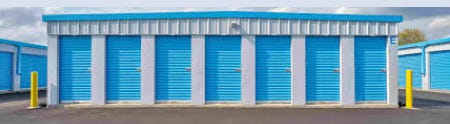
This morning I’m making a run to the storage unit in Glendale, where our remaining household goods lurk - imagined essentials from a climactic garage sale when we left L.A. for Mexico. I haven’t a clue what’s in there. Storage, in a city of low-slung dwellings with scant basements or attics, has become a growth industry, the rented unit an extension of the home. Even owners of sprawling, two-story spreads with large garages maintain storage containers for the spillover. Some use them as daily offices; others, I suspect, sleep in their concrete cubicles. These monuments to the conditional, the temporary, the transient, typify a town everyone is prepared to leave at any minute.
When I was growing up, my parents and their cronies used to parade the stock joke that they only bought Coke by the bottle, never a six-pack, because any minute they might be returning to New York, London, Rome, or Berlin. In fact, nearly all the ones I can think of stayed on and died here.
I roll the window down. East of the 405 interchange, the air abruptly loses its saltiness, warming by five or six degrees. Some days a gentle wind lofts the sea air farther inland; I’ve smelled it as far east as Chinatown, seen seagulls in Pasadena. People pay extra for view homes perched on the granite slopes of the Hollywood foothills, though many days the picture windows offer little more than a pall of particulate waste.
Accelerating, I feel the buffeting breeze rush through the open window. I think of Joan Didion’s Maria Wyeth in Play it as it Lays, daily driving these interchanges “as a riverman runs a river.” L.A. as sensory text, a kind of Braille for the sighted: a city in code, bearing letters in place of a name. But then freeways subvert the very idea of a city, which says: Slow down, enter the density, relate. Speed provides a substitute for experience - a quick release from history, especially one’s own. The on-ramp ascent, with its sudden velocity burst, is irresistible. The moment I got behind the wheel of a car at sixteen, I was lost to my parents forever. Every Southern California kid has the contours of this hurtling topography inscribed in his blood. Some lost it all driving (“Tell Laura I Love Her,” “Dead Man’s Curve”), the romance of road death conferring twisted, bloody immortality (James Dean, Carol Lombard). Surf rockers Jan and Dean were in my high school; Jan never did recover from his crackup.
Robertson, La Cienega, Fairfax. The off ramps fly by, each sign laminated with memory. We moved from house to house so many times - and I moved so often later on my own - I can probably claim a dozen neighborhoods as mine. Just before the LaBrea turnoff, I catch a glimpse of the hillside where one of our first L.A. houses stood - a two-story “Spanish” right above the Sunset Strip, a block west of the Chateau Marmont Hotel. My parents forbid me at six years old to walk the three blocks along Sunset to Schwab’s drugstore to buy comics, their fears of molestation or abduction unvoiced but keenly felt.
Past the Hoover exit, I bank left across the downtown interchange, the office towers ebony monoliths backlit by morning sun. In my years away, entire neighborhoods have been reconfigured by earthquake, riot, fire, erosion, ethnic shift, decay. (L.A.’s routine destruction in disaster movies is always considered a victory for civilization.) The smog has lessened over the years, though today’s toxins already gather at the base of the San Gabriels. When in 1934 Faulkner wrote his short story “Golden Land”, the term “smog” didn’t exist, though it was probably a chemical component of his California haze. Still, there was that baleful, noxious undertone in his description: too damn much sun. Perhaps Faulkner was describing a hangover, the kind he knew too well.
Downtown recedes, traffic clears ahead. Crossing three lanes at 70 miles an hour, I veer onto the Golden State Freeway. “The sun, strained by the vague high soft almost nebulous California haze, fell…with a kind of treacherous unbrightness…” Ominous, Faulkner’s description, partaking of a stylization he and Raymond Chandler and Nathaniel West didn’t quite invent but brought to a high gloss: California as suspect, ersatz Eden, needful of unmasking. It was LA’s good fortune to have had these alcoholic geniuses to deconstruct its Arcadian face, erect a counter-vision to the empty claims of developers, boosters, and hawkers: a literature of scorn. But nobody can scorn L.A. better than those of us who grew up here.
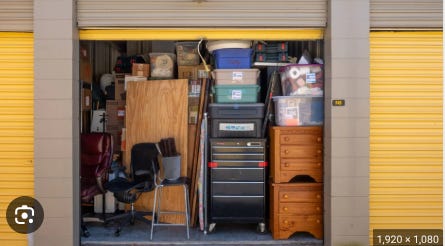
A block from the storage facility, I idle at a stoplight in the heat, inhaling the aroma of eucalyptus, exhaust, mowed wet grass. Across the railroad yard, in a vacant parking lot, a school marching band is rehearsing: “California here I come/Right back where I started from.” I watch a tumbleweed blow across the road until the light turns green. At the security gate, I enter a code and drive slowly down identical numbered corridors. I slip a key into a rusted lock, lift a corrugated metal door, and gaze helplessly at a tangle of driftwood washed up from a former life.
Thanks, Tony, for the memories. I, too, grew up in LA--born in Chinatown and as a kid moved a few times in the "Frogtown"/Lincoln Heights/El Sereno neighborhoods. In the late 1940s, I remember clear skies, Mt. Baldy was that crisp, sharp-edged hood ornament you mention, and I could ride my Schwinn along Riverside Drive, Los Feliz, all the way up to the Griffith Park Observatory, free to explore, an innocent in a wonderland of palm trees, beautiful homes and sweeping vistas to a shimmering sea. That was long before I read the likes of West and Didion and felt a bit of that ominous mental cloud besetting the newly arrived dreamers disillusioned in a place where failure is as common as the haze everyone describes. I left to see and live in the wider world, finally returning to a beach town in the LA basin. Now, avoiding commuter times, my wife and I can escape megalopolis on freeways to the deserts, to the mountains or, only a few hours away, even to Mexico.
Great stuff, Tony. Didn’t know you were here. I’ll be a regular.