
DRUMMING: A CODA
Back in California after two years in Japan, Anne and I rented a cabin in the woods south of Carmel, along the road to Big Sur. It had been occupied by the novelist and folk musician Richard Fariña and his wife Mimi, whose sister Joan Baez lived nearby. Fariña, a few weeks after I’d met him, would be thrown from a motorcycle following a publication party nearby celebrating his first novel, and killed.
It was in that cliffside cabin that we learned Anne was pregnant.
Build a house, write a poem, have a child. So had Robinson Jeffers, craggy bard of the Carmel coast, once counseled. I worked on a construction crew, laying up house frames in the fog in jeans and gumboots. I edited books for would-be local authors. At night I wrote at an old wooden table overlooking the thundering Pacific. Anne and I climbed among the tide pools and sea lion enclaves of Point Lobos; explored Henry Miller’s old Big Sur haunts; hiked Bixby Creek where Kerouac had spewed his amphetamine-fueled epic in Lawrence Ferlinghetti’s cabin.
One weekend I drummed with a pickup rock band at the Monterey Fairgrounds; Janis Joplin joined us for a couple of tunes. But after jazz in Europe and my Kyoto interlude, rock drumming felt clamorous, mindless, repetitive. My life as a working musician to all appearances behind me, I set out instead to finish the novel begun in Japan. At night I lay listening to the child kicking inside of Anne while US battleships on maneuvers fired rounds of artillery offshore.
Then one Sunday afternoon at Big Sur Hot Springs, I heard the North Indian sarod master Ali Akbar Khan perform a raga with a young Calcutta drummer. In these passionate, deep strains, I thought I heard a way out of the prison of Western musical forms. Sublime polyrhythms on the pitched pair of Indian hand drums, the tabla - a fount of metrics from the Indus, winding back to Sanskrit and the Vedas - seemed to weld music and speech, braiding the twin strands of my life together. When I learned that Ali Akbar and his drummer would be teaching classes in Berkeley that summer, I knew I had to be there.
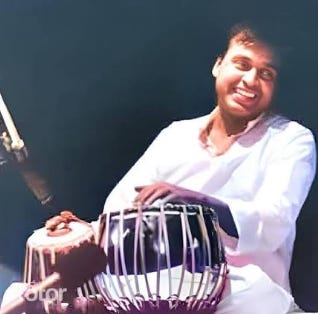
Ali Akbar Khan’s music school, founded by a wealthy newspaper heir and his wife who had a passion for Indian dance, drew a quirky band of disenchanted Western musicians to study at the feet of this genuine master. Working with the drummer I’d heard in Big Sur, I progressed relatively quickly - up to the level perhaps of an eight-year-old Indian student. I’d sit before the two drums, the smaller of wood, the larger of metal, each with a hide skin on top, producing an astonishing variety of sounds with fingers, hands, and the palms of the hand - though nothing compared with the range, speed, variety, and emotional inflections the best drummers wrung out of them. I began performing around the Bay Area in small concerts with all Ali Akbar Khan’s best sarod students.
Later that summer, the owners of the Indian music school announced the arrival of India’s new young lion of the sitar, “the next Ravi Shankar,” 32-year-old Nikhil Chatterjee, for a 3-month concert tour of the US. They needed a tour manager and a tamboura player. Seeing a chance to study one-on-one with a great tabla drummer, make a little money for my new family, and take a break from struggling Anne, I applied for the job and got it.
*
On a snowy morning after breakfast in Ames, Iowa, I sat on the motel floor across from Kumar, feet folded beneath me, with my hand drums, silver tuning hammer, and Johnson’s baby powder to dry my hands. Kumar, Chatterjee’s master drummer, recited patterns of sounds aloud - Dha deri kita taka. Kita taka deri deri - each syllable corresponding to a distinctive hand stroke on one of the two drums, all within the ornate rules of Indian metrics. I repeated them vocally; then we played the results in unison. If there was a drumming beyond jazz, beyond Africa even, this was it.
At eleven o’clock, Amiya, a young engineering student assigned to help us get around Ames, knocked on the door. Outside, snowflakes whirled. I grabbed my drums and luggage. We headed out into another day of travel.
At the airport, we were told our flight to Chicago was delayed because of snow conditions. We waited in a small coffee shop, Amiya stirring cardamom and other spices into our Lipton’s tea in styrofoam cups to make Indian chai. The three Indians giggled in Bengali, then Chatterjee turned to me and said, “Amiya comes from an old Calcutta family of fortune tellers. Not the usual chaps on the street. They are Brahmins, trained priests. Good families consult them on every important matter - birth, weddings, business matters.”
“I trained in palm reading for seven years,” Amiya said, “longer than for my doctorate in metallurgical engineering. When I go back to India I’ll practice both.”
The few planes on the tarmac were grounded, and none were landing. Amiya said something in Bengali. Chatterjee turned to me. “Amiya has offered to read our palms.”
Amiya, stirring his tea, smiled softly. Tall and lean, with limpet eyes and dark, sensitive features, he was dressed neatly, like an American student, in khakis and button-down shirt and loafers. “Only if you wish to, of course,” he said.
“You can start with me,” Chatterjee said jovially.
Amiya moved his chair across from Chatterjee’s and cradled the sitarist’s left palm in his hand. He studied it, tracing various lines with his forefinger.
“You see here,” Amiya said. “The lifeline is very strong. No breaks. You’ll live long. And here, it looks as if your wife - you’re married, yes? - will bear you a second child. Late next year. A son, it would appear.”
Chatterjee beamed with pleasure. “Yes, we’ve hoped for a son.”
“Really, this is an exceptional palm. The lines are clear, and correspond to each other properly. You will have a long life, great success in your career, many grandchildren.”
Chatterjee lowered his head modestly, thanked Amiya in Bengali.
But, then, this was hardly a surprise. Chatterjee seems to have everything going for him. From a high Brahmin family, his path had been smooth from childhood. At thirty-two years old - five years older than I - he already had fame, money, a wife, and two children, and was nearing the peak of his art, the heir apparent to Ravi Shankar. Living within an art sanctified by centuries of culture and tradition, he was spared the vain, individualized Western search for identity. He seemed to have little neurosis about him, only humility, calm, and stunning command on his instrument. I envied but didn’t begrudge him his good fortune. That it would last throughout his life made sense to me.
Kumar’s palm was a mixture of good and ill fortune. He’d been sent to study music as a boy and had quickly risen through the ranks of India’s young players. A fiery drummer, he’d performed on a famous recording with Ravi Shankar when he was still quite young, and now, in his late 30s, was a highly revered player. Amiya’s reading suggested he’d have a reasonably long life with a few setbacks and injuries, including an upcoming illness in the family. His musical trajectory wouldn’t take him much higher than this. Kumar seemed unsurprised at the reading, and reasonably content. His fortune, too, seemed to add up.
The readings were deep, and we were growing serious around the table.
Amiya pulled his chair across from me, took my upturned left palm in his. He smoothed it out as if it were a piece of parchment. He studied it for a long time, his dark forefinger gently tracing the indentations. Then he spoke softly - reluctantly, it seemed: “Your present work will not last, and you will abandon it.”
I wondered what work he was referring to. Tour manager? Tabla player? Sometime editor, unemployed musician, unpublished novelist? What in fact was my work at this point?
Then Amiya said, “I’m sorry to tell you, but your marriage will not last much longer.”
I looked dully at the floor. How to respond to this, even to think about it? I’d been missing Anne and our new little girl terribly lately and couldn’t wait to get back to them; yet in some uncanny way Amiya’s prediction didn’t come as a surprise.
Amiya said something in Bengali. Chatterji said, “He wants to know if it’s all right to tell you the rest.”
“Of course.”
Amiya said, “You are greatly torn between spirit and matter. You will achieve some fame.” He traced the line running up the center of my palm. “And see here? This is the lifeline. It is broken.”
“What does that mean?”
Amiya looked carefully up at me. “You will die in middle age, violently, while traveling.”
I looked down where Amia’s finger lingered on the deep fissure curving up the middle of my palm. Clearly it was sundered midway, breaking jaggedly off from its root, then crossed by another line. The fatal rupture lay before my eyes.
“I am very sorry,” Amiya said, his large brown eyes regarding me with helpless compassion.
I felt numb, as if the snow and ice and gray sky outside the airport waiting room had entered through the glass into me. The sounds of the airport dimmed, the fluorescent lights seemed to flicker weakly. Kumar and Chatterjee looked off into the air, anywhere but at me.
*
On the plane to Chicago I sat next to Chatterjee. His long, beautiful wood sitar with its seventeen metal sympathetic strings and ornate inlaid ivory rested in the seat next to him.
Your present work will not last. True, as my 27th year came to a close, I had no idea what I wanted to do next with my life. This was a thorny matter Amiya had unearthed in my palm. Did I imagine I’d become an Indian master drummer at this late date? Now I had a wife and child to support, and no money but what this tour would put in my pocket. My wanderings, my murky struggles with art and identity, had added up to little. A hopeless eclectic, a perennial student (a term thrown at me by my father,) a financial flop, I saw friends and family giving up on me. Lately I could read it in their eyes. A botched life, foretold in my palm, a text etched into my very skin.
Your marriage will not last much longer. Anne and I had been having difficulties since the beginning. Sometimes I wondered if marriage, Japan, the pregnancy weren’t just strategies to raise the stakes with new commitments. Her unfathomable sadness only seemed to worsen. Was it my fault?
You will die in middle age, violently, while traveling. The verdict tolled like a judgment. So it was all worthless anyway, the remaining years a mere hollow, abortive exercise. Where would my end come, and when? And when did middle age commence?
Chatterjee, seeing me glumly sunk down in myself, said, in his chirpy Indian English, “These boys are correct. It is a science. But you must remember” - he reached over and tapped my knee - “there is always the element of will. You can change your fate by your own intention. I have seen the lines of the palm change on a man. So don’t be so downcast, my friend.”
I looked at him miserably.
“No destiny is absolute,” he said. “By your own efforts you can improve your karma. Besides, when you think about it, isn’t this what we are all doing, whatever our state? All we can do is our best during our allotted time.”
As the plane dropped through snowy cloud cover onto the O’Hare runway, Chatterjee’s words, tendered as consolation, served only to distance his perfect fate further from my hopeless one. I stood and left the plane, a walking ghost, trapped inside the cracked shell of a futile, abbreviated life.
A few nights later, it seemed all of trendy New York turned out at Town Hall - rock idols and ballet stars, film celebrities and critics, musicians of every stripe and idiom. The Indian community in its best finery mingled with newly minted celebrities. Chatterjee’s rich, meditative morning raga, transporting in beauty and depth, made his name in the city. After intermission, an evening raga built to an exhilarating call-and-response, a flurry of counterrhythms and wit, bringing the crowd to its feet. Sitting behind Kumar and Chatterjee with my tamboura in the photo that appeared in the newspapers, I was proud for my maestros, the travails of the tour behind us. We took three encores.
A few days later, I was back in North Beach with Anne and our baby daughter, exhausted and emptied. My final check arrived, enough to last us through Christmas and beyond. Anne seemed even more distant, unreachable. We’d sit on the bed at night trying to talk about it, but I couldn’t get through to her. I had missed her and our daughter so terribly much; now, home at last, I felt like a stranger.
Ten days after my return, heartbroken and dazed, I left our apartment in North Beach, Amiya’s dire predictions echoing in my ears. Our split had played out with the mute inevitability of a dream. I hitched my way south down Route 1, through Big Sur, hoping to find work in LA, another life, some path of escape from the message of doom engraved in my palm.
*
When does middle age commence? Thirty-five? Thirty-eight? I’d often wonder in the years following the palm reading in the Ames airport.
I traded aerograms with Kumar and Chatterjee for a year or so after the tour, then they dried up. Once I was in London and saw a poster announcing Chatterjee’s concert appearance at a large auditorium the next night.
In the years to follow - well into middle age, however one chooses to define that term - I moved through the world stalked by a shadow. At the outset of every voyage - and there were scores of them, almost as if I was compelled to test my fate - with each lifting of a plane of a runway, each lurching forward of a train or bus or car, a knot gathered in my stomach, a sense of involuntary surrender, and a tension as familiar as my own breath. Maybe this one is it. I was a man waiting to die.
One evening, at a dinner at a friend’s house in the Hollywood hills, I found myself sitting next to a woman I’d known in Berkeley years ago, at Ali Akbar Khan’s music school. A pretty woman, now more perhaps than in her youth, her gray hair tied back in a bun, she was one of those who, like me, had found breathing space in cultures not her own. Unlike me, she had kept in touch with the Indian musicians - I recalled she’d had a romance with one - and she was dressed in a sari that evening, with the puja, the red dot, on her forehead. We began to talk about those days years ago. When I mentioned my tour with Chatterjee, a frown crossed her face.
“It’s so awful what happened,” she said. “And to such a great artist.”
“I’ve been out of touch,” I said. “Tell me.”
“Well, I saw him in concert two years ago. He looked terrible even then from the heart condition. By his recital here a year ago he’d wasted away to nothing. Such a wonderful man, and of course the great sitarist of his generation. Now he can barely walk. He only performs occasionally, and then one raga at most.”
It was devastating news. Chaterjee, of all men. How undeserving of such a fate, I thought. Then, commingling with the shock and sorrow, came the other dawning realization.
I excused myself and stood up. I walked quickly through the living room and stepped out onto a balcony, fighting for air.
I looked at the city lights below, a tangle of thoughts whirling through my head. Amiya had been wrong! If Chatterjee’s perfect future was false, then so was my doomed one! Amiya knew nothing! It isn’t an exact science at all!
But what of the split with Anne? The abandonment of my musical path? Hadn’t Amiya seen all that? No, of course not. He’d predicted a few things by mere chance, and I’d yoked his random prophecies to my own grim ends.
Then I thought: What if Chatterjee had, for some unfathomable reason, changed his palm for the worse by the force of that very same will he spoke of? But, recollecting the months spent with that cheery man, and the message in his music, I found this impossible to imagine.
Gazing out across the lit expanse, I felt a wave of sadness rise and engulf me. Then I began to laugh, darkly and bitterly. Tears streamed down my face, my stomach hurt. All those years enslaved to a bogus divination! The city lights below seemed brighter, as if a current of extra voltage surged through them. If I were to die while traveling - a reasonable prospect, considering how much I did of it - it certainly wouldn’t be because it had been foretold by a palm reader in the Ames, Iowa airport.
Fortune tellers, soothsayers, purveyors of bullshit. Welcome to a long, successful life.
I don't know your birth date but am so glad you were born, and are still with us with your new karma...I see your palm, it has changed its message in the lines, from drumming...you will have a very long and loving life, with many surprises.