
ARTISTS/WRITERS: BOWLES
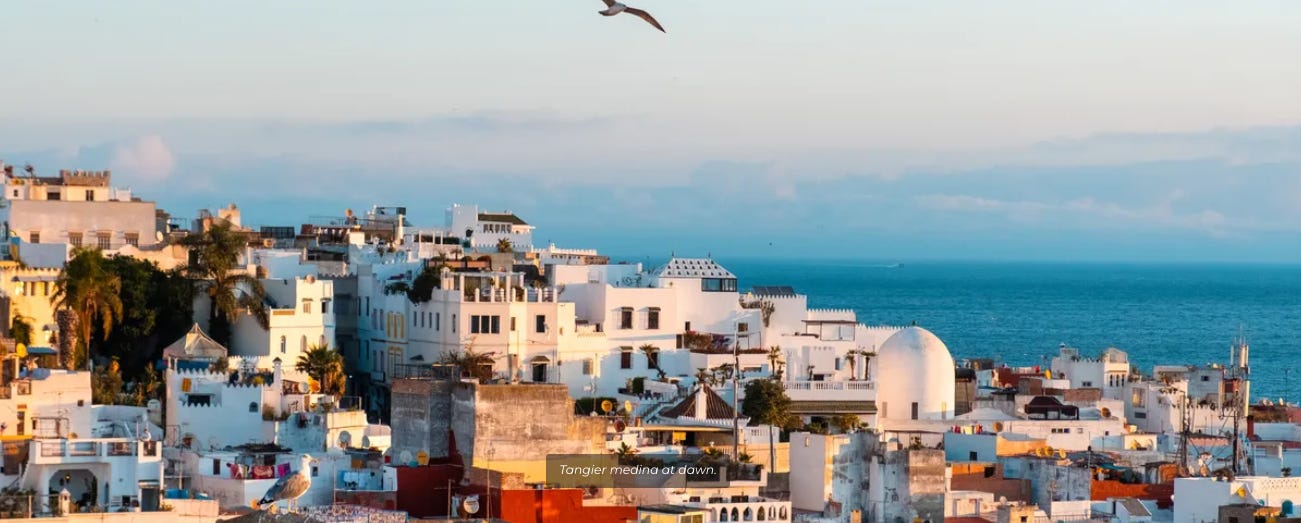
A soft Atlantic breeze swept the ferry deck. Behind me, Gibraltar’s sere scarp shrank away. Ahead, a white city spilled down its hills to a crescent harbor.
Approaching the dock, the Algeciras-Tangier ferry reversed engines. I looked down into the roiling waters, feeling a languid indifference to my fate.
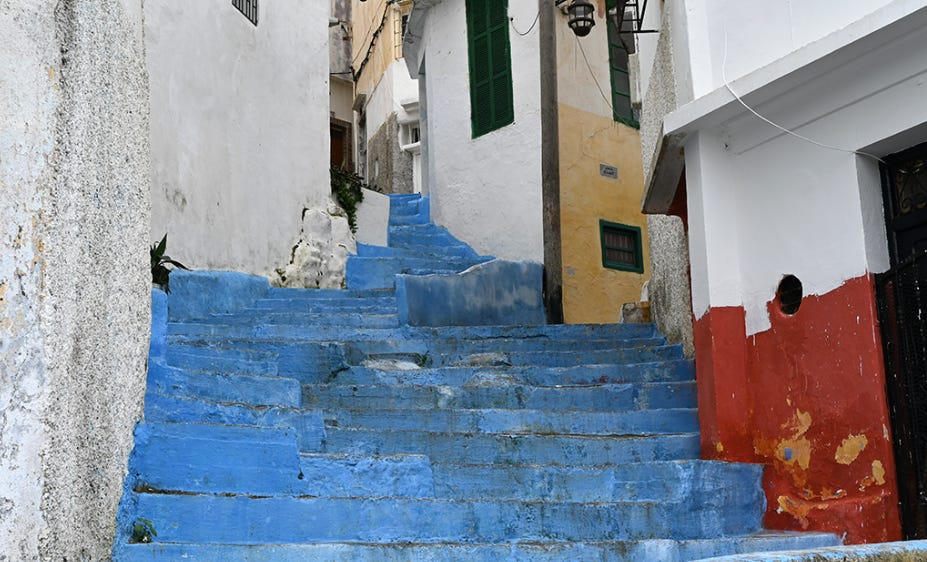
As I stepped off the ferry onto the wharf, Arab guides accosted me with offers of drugs, arms, sex, currencies. I climbed from the harbor up into the old medina and followed a maze of narrow shaded alleys. Deep in the quarter, I came to the low, blue, oddly shaped door I’d been told to look for by a musician in Paris. After a number of knocks, an ethereal blonde girl of no more than six opened it and, with a serious look, beckoned me in.
I trailed her through a warren of whitewashed rooms of different heights, sizes and shapes. I smelled the sticky sweet aroma of mint tea and hashish. In one room a bearded European was curled up on a mat; in another, an Arab man in a djellaba and skullcap was cutting up kif leaves on a flat wooden board, the little round seeds rolling across the tiles. There was little light and no furniture. In a long central room strewn with pillows, a half dozen Europeans and Arabs sat around smoking kif from pipes, sipping mint tea, and talking in low tones.
I was introduced to Galen, a small, rumpled American in his thirties who offered me an empty room to sleep in. His Russian wife, Tetyana, drifted in and out of the rooms, pouring tea and tending to their two little blonde daughters.
Galen was an amateur scholar and drug aficionado, who from his house in Tangier’s Casbah corresponded with European and American doctors, researchers, drug connoisseurs and academics across the world - Leary, Huxley, the Swiss physician Albert Hoffman who first synthesized LSD - conspiring to bring about a revolution in Western consciousness. Alcohol was belligerence, dope pacific; war was straight, peace high. Cannabis, acid, peyote and psilocybin would transform the lethal American Cold War vision into a kinder, gentler one. To these committed drug romantics, history was a seamless, stoned epic in which every important historical figure from Sophocles to Napoleon to JFK owed his accomplishments to the use of transformative substances: opium, hashish, mushrooms, yage, laudanum, ayahuasca. Soon all of Western youth would be smoking weed and taking psychedelics, an assertion that seemed quixotic to me at the time but would be borne out, though hardly ushering in Galen’s millennial change in consciousness.
Characters of every nationality and description drifted in and out of Galen’s house at all hours: dealers and hustlers, poets and musicians, scholars and artists, heiresses and aesthetes. What united them was dope: a cult of cannabis sativa and hallucinogens.
I found this messianism peculiar. I’d never thought of drug experience as an end in itself, or as an instrument of social revolution, but at most an aid to creation. Certainly among musicians the aim of getting high was to enhance performance.
When the wild speculation, bad poetry, and rumors of drug busts became too much, I’d slip out into the alleys of the Casbah, hallucinatory in themselves. I’d hike up through the crumbling medina, willfully lost, unable to separate the effects of the kif from the dreamlike reverie of the city.
Sometimes I’d cross the Socco Grande into the old French quarter and take a table at the Café de Paris, where an international crowd met to read the journals, smoke, and conspire. Among the habitués was a tall, pale American writer whose small novel, written ten years earlier, had been pressed upon me by a writer staying at Galen’s. I’d read The Sheltering Sky in a sitting, enraptured by its lucid, unflinching gaze into the void. It had left me with a hunger to travel further south, into the desert, the tale’s primary landscape.
Sometimes I’d see Bowles’s writer wife, Jane, distractedly trailing an Arab woman through the streets. One night she appeared at Galen’s house in an agitated state, claiming a spell had been put upon her. Allen Ginsberg and Tennessee Williams had just left Tangier, as had William Burroughs, a writer unfamiliar to me; but at Galen’s I’d come upon two small, interesting pamphlets of his employing an experimental cut-up method of writing that seemed to mirror perfectly my own fracturing consciousness. His novels Naked Lunch and The Soft Machine had just come out in Paris, though nobody in Tangier had copies yet.
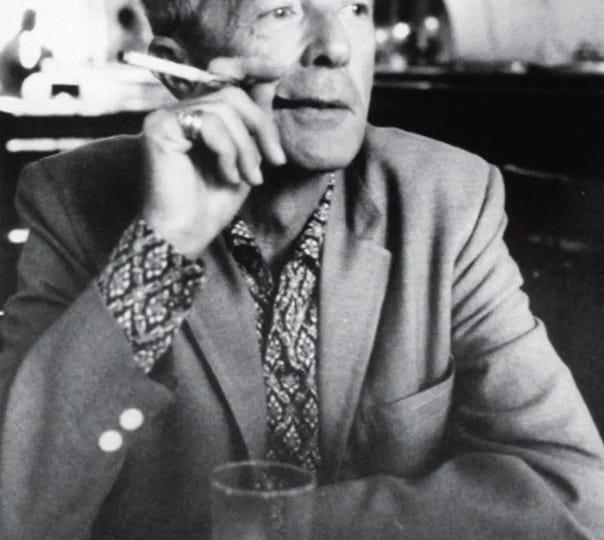
The heiress Barbara Hutton had a villa at the summit of the casbah overlooking the harbor where she often entertained. Galen and his crowd were generally on the guest list. One night at one of her parties Paul Bowles was in attendance, tall and lean, in a white suit, smoking hashish and paying great attention to the Arab musicians holding forth. I wanted to talk to him about both his book and his ethnomusicological interests (a composer as well, he’d recently made a series of field recordings of Moroccan music for the Library of Congress), but the kif had rendered me shy, speechless. Jane Bowles, entering dementia, cowered in the corner with her lover Cherifa. The rooms pulsed with local oud orchestras, hermaphroditic dancing boys, joujouka trance musicians from the Rif mountains, a Ghanaian dance troupe en route to Paris. Dancers whirled, pipes were refilled. Nearly everyone I’d seen in Tangier was there, and by midnight the revelry had reached a fever pitch.
“I’m going to Marrakech to hear the Gnaoua drummers,” I heard myself blurt out to Bowles.
“Oh they play in the Djmaa el Fnaa, the grand square, every day this time of year,” he said pleasantly, sounding no less strange than the rest of us. He seemed good-humoredly indifferent, neither kind nor unkind.
I told him I’d read The Sheltering Sky and wanted to know where I could buy a copy.
“Out of print, I’m afraid. As is all my work,” he said. “But let me know how you find the Gnaoua when you get back to Tangier.”
I promised I would.
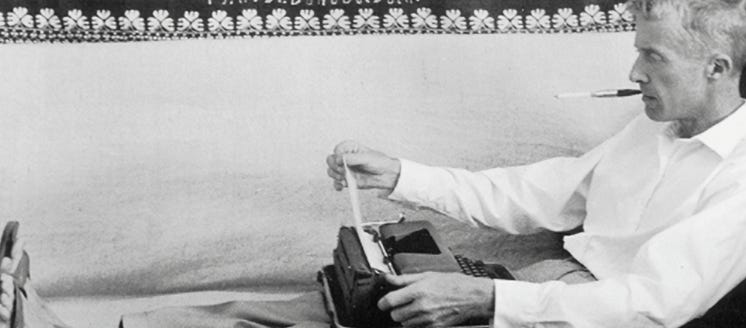
Though I’d never see Bowles again, we’d keep in touch through the years. Chatty letters, typed on thin blue aerogrammes with odd little Moroccan postmarks and stamps would arrive, full of droll news of Ramadan, police crackdowns, Arabs and foreigners amok in the medina.
At that point, Bowles was essentially a forgotten figure, his books mostly out of print until a revival began in the mid-70’s. In 1977, he sent me a story to include in an anthology I was editing. Then Bernardo Bertolucci made his film of The Sheltering Sky, in which Bowles appears. By the time of his death in the spring of 2000 he’d become a literary icon.
Meeting Bowles probably marked the beginning of my life as a writer. In him, I found an American of my father’s generation who’d neither compromised his life for commerce nor lived in the United States. His novels, short stories, travel writings and letters became steady companions. If my literary training had left me impatient with many Beat writers’ lack of rigor and restraint, I found in Bowles a writer who combined formal cool with radical, unsparing vision. Through him I understood how a musician might also write, a path I was on without yet knowing it. More deeply, I sensed in him someone who, as another writer would later note, “retained, everywhere, the singularity of a stranger.” I was beginning to understand that I had no true home and might be fated to never find one, but that I might become one of those equally at home everywhere and nowhere. Through Bowles’s example, I gleaned there were other ways of being American, alternatives to the suffocating vision promulgated by the society I’d grown up in.
In Tangier at that time, a week seemed like a year. Artistic and psychic investigations were undertaken at a high cost: dementia, visions, death. It might be said that, in a sense, the next stages of social and artistic development in the West were prefigured in Tangier during that brief time. Galen’s mad prophecies would soon become everyday American realities, his colleagues culture heroes. For years I’d run into poets, artists, musicologists, editors who shared Tangier at that time as an abiding reference - a disturbed and disturbing force field that included many things, of which Paul Bowles and his work were inevitably one.
He would remain as I first encountered him, the calm eye of the storm while those around him went variously mad. Writing under a steady dosage of kif, he was the only seriously good writer I’d meet who managed to work well stoned over the long haul. His writings opened up the Arab world and brought us to the desert, though in truth he had many British and German precursors (including the remarkable Isabelle Eberhardt, whom he translated). But is it in his lean, luminous style and fearless existential vision of emptiness that his work endures.
Sometimes in his letters I’d hear a note of melancholy. Jane had died in a nunnery in Spain, the theater of Tangier had passed, he was translating in lieu of writing. I returned to Morocco a number of times over the years but out of reticence never visited him in his small flat in the Iseta building (there was no telephone; you simply showed up at his door).
I never did like Tangier except for its setting; it’s one of the most corrupt, claustrophobic places I’ve ever been. But that first day I arrived on the ferry and entered the Casbah, I was changed. As Europe liberated me from America, so did the Arab world release me from the West. On later trips I’d spend a night at most in Tangier then move on, feeling a sense of relief when I crossed the High Atlas and got the first whiff of the silent desert Bowles wrote about so unforgettably.
"Soon all of Western youth would be smoking weed and taking psychedelics, an assertion that seemed quixotic to me at the time but would be borne out, though hardly ushering in Galen’s millennial change in consciousness." Yeah, we got fentanyl and meth instead.